

How to Clean a Reusable Water Bottle and Finally Get the Smell Out
My insulated bottle had developed a smell that survived the dishwasher, and the straw and the silicone gasket in the lid were the real culprits, not the bottle itself. Rinsing with water does almost nothing to the biofilm that causes bottle funk. Here is the routine that actually got the smell out, ranked by how well each method worked on the parts that trap the most grime.
Jump to a section
- What you'll need
- Step-by-step
- Take the lid fully apart and understand where bottle smell actually lives
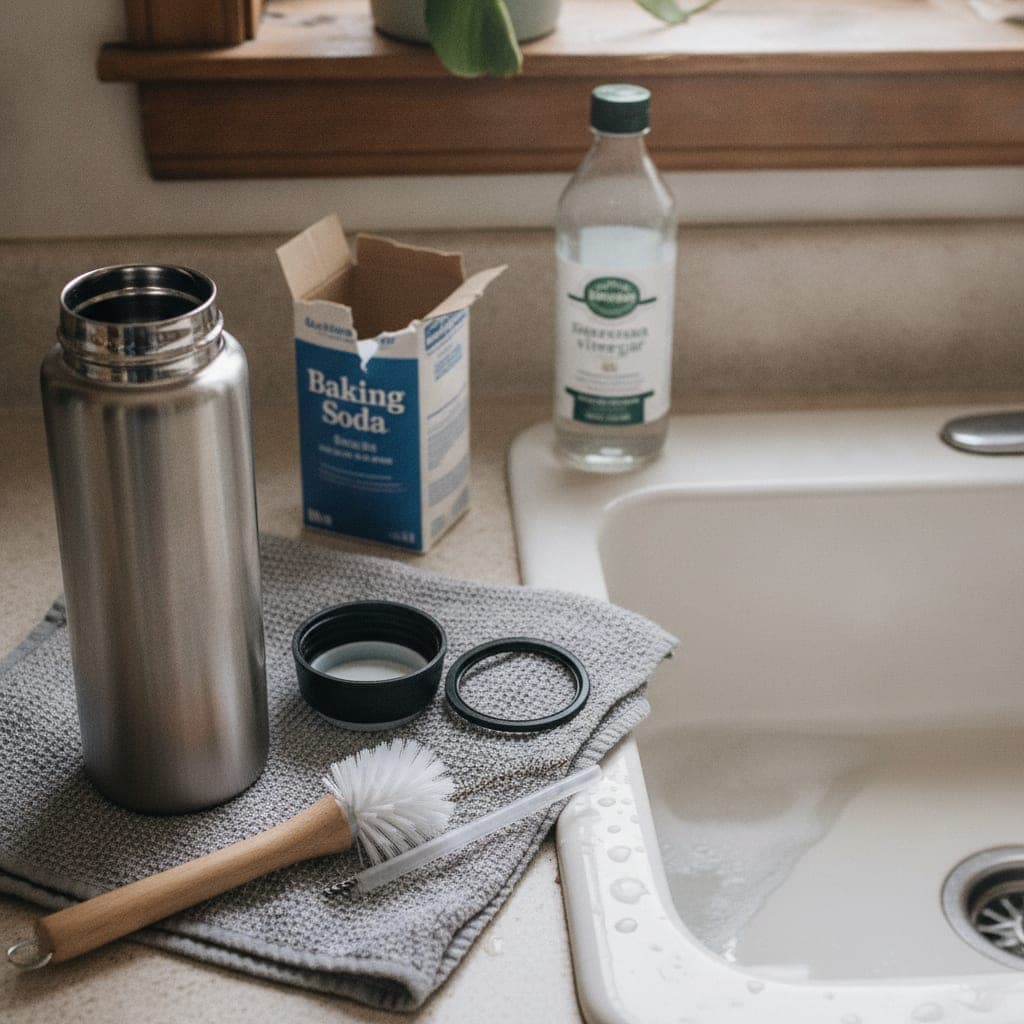
- Scrub the bottle body with a baking soda paste and a proper bottle brush
- Soak the bottle and lid parts in a vinegar solution to break down biofilm and odor
- Run the straw brush and clean the gasket, the two worst offenders
- Dry every part fully with the lid disassembled, because trapped moisture is the whole problem
- Know which parts are dishwasher-safe and which are not
- Pro tips
- FAQ
What You'll Need
Step-by-Step Instructions
Take the lid fully apart and understand where bottle smell actually lives
Before cleaning anything, take the lid completely apart, because the smell almost never comes from the bottle body, it comes from the parts most people never separate. Pop out the silicone gasket or O-ring that seals the lid, unscrew or detach the spout, flip cap, or bite valve, and pull the straw out if there is one. The reason a bottle keeps smelling even after washing is biofilm, a thin slimy layer of bacteria that forms wherever moisture sits undisturbed, and it concentrates in exactly the spots a quick rinse and even a dishwasher cycle cannot reach: the underside of the silicone gasket, the inside of the straw, the threads of the cap, and the narrow channel of a flip-top spout. Water on its own does essentially nothing to biofilm because the slime physically protects the bacteria underneath it; you have to mechanically scrub it loose or chemically break it down. Sniff each part separately once the lid is apart and you will usually find the smell is coming from the gasket or the straw, not the bottle, which tells you where to focus.
Scrub the bottle body with a baking soda paste and a proper bottle brush
For the bottle body, the combination of a mild abrasive and a brush long enough to reach the bottom does the real work. Make a paste of a tablespoon of baking soda with a little water, or just add a teaspoon of baking soda and a drop of dish soap with warm water, and scrub the entire inside with a bottle brush that actually reaches the bottom corners, where a sponge or your fingers never touch. The baking soda is gently abrasive enough to lift biofilm and absorbs odors at the same time, which is why it beats dish soap alone for a bottle that already smells. Pay attention to the bottom edge where the wall meets the base, a curved trap where residue collects and brushes often skip. For narrow-mouth bottles, a bottle brush is not optional, because there is no other way to physically reach and scrub the interior, and physical scrubbing is what removes biofilm. Rinse thoroughly. If the bottle is stainless steel and has developed a metallic or musty smell, the baking soda scrub followed by the vinegar soak in the next step handles it far better than soap.
Soak the bottle and lid parts in a vinegar solution to break down biofilm and odor
For odor and biofilm that scrubbing alone does not fully clear, a vinegar soak is the most effective home method. Fill the bottle with a solution of one part white vinegar to two parts warm water, drop the separated lid parts, gasket, straw, spout, and cap, into a bowl of the same solution, and let everything soak for at least thirty minutes, or up to a few hours for a stubborn smell. The acetic acid breaks down the biofilm matrix and neutralizes the odor compounds, reaching into the crevices of the gasket and the inside of the straw that a brush cannot fully scrub. After soaking, scrub the bottle again briefly and run a straw brush through the straw while it is still wet from the vinegar, because the soak loosens the biofilm and the brush then carries it out. Rinse every part very thoroughly with clean water until there is no vinegar smell. For an even stronger option on a badly neglected bottle, an effervescent denture or bottle-cleaning tablet dropped into a full bottle of warm water fizzes its way into crevices and works well overnight, though vinegar handles most cases. Vinegar earns its place in the kitchen for dozens of jobs like this, as our how to clean almost anything with vinegar guide lays out.
Run the straw brush and clean the gasket, the two worst offenders
The straw and the silicone gasket are where bottle smell is born, and they need dedicated attention that no soak fully replaces. A straw is a long narrow tube that stays wet inside and never gets scrubbed by anything in normal washing, so biofilm builds along its entire inner wall; the only fix is a thin straw brush pushed all the way through and worked back and forth several times, ideally after the vinegar soak has loosened the slime. If you do not own a straw brush, they are inexpensive and are the single most useful tool for a straw bottle. The silicone gasket traps moisture and grime in the groove on its underside and against the lid seat it presses into, so peel it out completely, scrub both sides with a soapy toothbrush, and make sure the groove is clear. A gasket that has absorbed a deep smell that will not wash out can be soaked in vinegar, and if that fails it is cheap to replace, because a permanently smelly gasket will re-contaminate an otherwise clean bottle every time you close the lid.
Dry every part fully with the lid disassembled, because trapped moisture is the whole problem
Drying is the step that actually prevents the smell from coming back, because biofilm only grows where moisture sits, and a bottle put away wet with the lid screwed on is a sealed, dark, damp chamber, the perfect incubator. After washing, leave the bottle upside down to drain on a dish rack and leave all the lid parts separated and spread out to air-dry completely before reassembling. Never store a bottle with the lid screwed on while any part is still damp inside, and never leave it sealed in a gym bag overnight with a little water in the bottom, which is how most bottles develop their smell in the first place. For insulated bottles that dry slowly because the vacuum wall keeps them cool, stand them upside down in a sunny spot or stuff a clean dry dish towel inside to wick the moisture out. Storing the bottle with the cap off or just loosely set on top, rather than sealed tight, keeps air moving through it between uses and is the simplest habit for keeping a clean bottle clean.
Know which parts are dishwasher-safe and which are not
The dishwasher helps but does not solve the problem, and using it wrong damages bottles. Many stainless-steel insulated bottles are not dishwasher-safe, because the high heat can compromise the vacuum seal that keeps drinks cold and can damage the exterior finish, so check the bottle's markings before putting it in. Even when the bottle is dishwasher-safe, the dishwasher does not reliably clean the inside of a straw or the underside of a gasket, because water does not flow through those tight spaces with enough force, which is exactly why bottles come out of the dishwasher still smelling. Put dishwasher-safe lids and parts in the top rack, but always pull the gasket and straw and hand-clean those separately. If your bottle is hand-wash-only, the baking soda scrub and vinegar soak in this routine fully replace the dishwasher and actually do a better job on the smell-causing parts. The takeaway is that the dishwasher is a convenience for the easy surfaces, not a substitute for disassembling and hand-cleaning the lid. And if the dishwasher itself has started to smell, that funk transfers to everything inside it, which our how to clean a dishwasher guide fixes at the source.
Set a cleaning rhythm so the smell never gets a foothold
Bottle smell is a maintenance problem, so the fix is a rhythm rather than an occasional rescue clean. Rinse the bottle and at least flush the straw with water after every single day of use, and empty it rather than leaving water sitting in it overnight, because biofilm starts forming within a day in standing water. Do a proper wash with the bottle brush and dish soap every couple of days for a bottle you use daily, and disassemble the lid fully for that wash rather than just rinsing the cap. Do the full vinegar soak weekly, or any time you notice a smell starting, because catching biofilm early when it is thin is far easier than removing an established, thick layer. If you carry the bottle in a gym bag, never seal it wet, and if you fill it with anything other than water, juice, electrolyte drinks, coffee, the sugars accelerate biofilm dramatically and the bottle needs a full wash that same day rather than the next.
What got the smell out, in order of impact
Separating the lid and cleaning the gasket and straw individually was the single change that fixed a smell I had been fighting for weeks, because I had been washing the bottle body, which was never the problem, while the biofilm sat untouched in the straw and under the gasket. The vinegar soak was the most effective single method for actually breaking down the established biofilm; baking soda scrubbing helped and deodorized, but on a smell that was already entrenched, the thirty-minute vinegar soak did what scrubbing alone could not reach. Running a straw brush through after the soak, rather than before, mattered more than I expected, because the soak loosened the slime and the brush then carried it out instead of just polishing the surface. The habit that kept the smell gone was drying the parts fully with the lid apart and never sealing the bottle wet, which removed the standing moisture that biofilm needs. The dishwasher, which I had assumed was doing the cleaning, turned out to be the reason the smell persisted, because it never cleaned the straw or gasket at all. If you only do one thing, take the lid apart and soak the gasket and straw in vinegar.
Mistakes that lock in the smell or damage the bottle
Mistake one: only rinsing with water and assuming that cleans it. Water does essentially nothing to biofilm, which physically shields the bacteria underneath, so a rinse-only bottle keeps smelling no matter how often you do it. You must scrub or chemically break the biofilm down. Mistake two: never separating the lid. The gasket, straw, and spout trap the most grime in the whole bottle, and a lid washed in one piece leaves all of it in place, which is why the smell survives the dishwasher. Mistake three: putting an insulated stainless bottle in the dishwasher without checking. The heat can break the vacuum seal that keeps drinks cold and damage the finish; many insulated bottles are hand-wash-only. Mistake four: storing the bottle sealed while damp. A wet bottle with the lid screwed on is a dark, sealed incubator, and is how most bottles develop their smell in the first place, so always dry fully and store with the cap off or loose. Mistake five: leaving a permanently smelly silicone gasket in place. If a gasket will not lose its smell after a vinegar soak, replace it, because it re-contaminates a clean bottle every time you close the lid.
Pro Tips
- ✓Take the lid completely apart and clean the gasket and straw separately. They trap the most biofilm in the whole bottle and are the real source of the smell, not the bottle body.
- ✓Soak the bottle and lid parts in one part vinegar to two parts warm water for thirty minutes, then run a straw brush through. The soak loosens biofilm so the brush can carry it out.
- ✓Never store the bottle sealed while damp. Dry every part with the lid apart and keep the cap off or loose between uses, because standing moisture is what grows the smell.
Frequently Asked Questions
Why does my reusable water bottle smell even after I wash it?
The smell comes from biofilm, a thin slimy layer of bacteria that forms wherever moisture sits undisturbed, and it concentrates in the parts a quick wash never reaches: the underside of the silicone gasket, the inside of the straw, and the cap threads. Water alone does nothing to biofilm because the slime shields the bacteria, and a dishwasher does not flow water through a straw or under a gasket with enough force to clean them. Take the lid fully apart, scrub the gasket and straw separately, and soak everything in a vinegar solution to break the biofilm down.
How do I get the smell out of a water bottle straw?
Soak the straw in a solution of one part white vinegar to two parts warm water for at least thirty minutes to loosen the biofilm coating the inside, then push a thin straw brush all the way through and work it back and forth several times while the straw is still wet. The brush carries out the loosened slime that the soak alone leaves behind. A straw is a long narrow tube that stays wet and never gets scrubbed in normal washing, so a dedicated straw brush is the only reliable way to clean it.
Can I put my insulated water bottle in the dishwasher?
Often not. Many stainless-steel insulated bottles are hand-wash-only because dishwasher heat can compromise the vacuum seal that keeps drinks cold and can damage the exterior finish, so always check the bottle's markings first. Even for dishwasher-safe bottles, the dishwasher does not reliably clean the inside of the straw or the underside of the gasket, which is why bottles often come out still smelling. Always pull the gasket and straw and hand-clean those parts separately regardless.
How do I keep my water bottle from smelling in the first place?
Rinse the bottle and flush the straw after every day of use, and never leave water standing in it overnight, because biofilm starts forming within a day. Do a full wash with a bottle brush and dish soap every couple of days, disassembling the lid each time, and a vinegar soak weekly. Most importantly, dry every part completely with the lid apart and store the bottle with the cap off or loose rather than sealed, because a bottle put away wet and sealed is a dark, damp incubator for the smell.
How this guide was made
This laundry kitchen guide was researched, written, edited, and published by Fredler Pierre-Louis. The 9 steps below are built around Baking soda, White vinegar and Bottle brush, and the quantities and dwell times come from published cleaning-chemistry and manufacturer guidance for those materials, not from a controlled trial we ran ourselves. Where a popular version of this hack does not work, or is risky on a particular surface, this 9 min guide says so.
- Checked against manufacturer and materials guidance for the surfaces named.
- Reviewed by a person for chemical safety and surface compatibility before publication.
- Written to explain why a method works, not just to list steps.
- Corrected whenever a reader reports an error or an edge case we missed.
Read our full editorial policy or learn more about the team behind TryCleaningHacks.
Related Cleaning Guides
Safety Notes
- ⚠Check whether an insulated stainless-steel bottle is dishwasher-safe before putting it in. Dishwasher heat can break the vacuum seal that keeps drinks cold and damage the finish.
- ⚠Rinse all parts thoroughly after a vinegar soak until there is no vinegar smell, so none is left to flavor your next drink.
- ⚠Replace a silicone gasket that keeps its smell after soaking rather than reusing it, because it will re-contaminate the clean bottle every time you close the lid.
You might also like
How to Get Rid of Kitchen Sink Odor (10 Easy Fixes)
My kitchen sink smelled no matter how often I cleaned it until I figured out what I was actually missing. The fix wasn't a new product; it was addressing three different sources at once. Here's what finally worked and the one mistake that kept the smell coming back.
How to Clean Stainless Steel Appliances Without Streaks (9 Methods)
Stainless steel appliances streak for one reason that almost every cleaning attempt gets wrong, and it has nothing to do with which product you buy. Stainless has a directional grain, and wiping across it drags residue into the grooves instead of out of them. Here are nine methods ranked for built-up fingerprints and kitchen grease, and the technique that decides whether any of them work.
How to Clean and Deodorize a Garbage Disposal (10 Easy Methods)
A garbage disposal that smells despite regular rinsing is almost never smelling from the grinding chamber, which is why citrus peels and vinegar never fix it. The odor comes from the underside of the rubber splash guard, a surface most people have never lifted or looked at, where a food film builds up out of reach of the water. Here is how to clean it properly and the routine that keeps it odor-neutral.