

How to Sterilize a Kitchen Sponge (5 Methods Ranked by Effectiveness)
A kitchen sponge is warm, permanently damp and full of food, which is close to a perfect environment for bacteria, and rinsing it under the tap does very little about that. Of the five methods people reach for, the ones that work share a single feature: they get the inside of the sponge hot, or wet with a real disinfectant, for long enough to matter. The ones that do not work fail for the same reason in reverse. Here is each method with the actual technique, ranked by how much it does, plus the more uncomfortable point that none of it lasts long and what to do about that.
Jump to a section
- What you'll need
- Step-by-step
- Why a sponge becomes a problem in the first place
- What sterilizing can and cannot mean in a kitchen
- Ranked 1: the dishwasher on a sanitize cycle with heated dry
- Ranked 2: boiling, which is the most reliable thing you can do on a stovetop
- Ranked 3: the microwave, effective but the one with real hazards
- Ranked 4: a dilute bleach solution, the strongest chemical option
- Pro tips
- FAQ
What You'll Need
Step-by-Step Instructions
Why a sponge becomes a problem in the first place
Four conditions drive bacterial growth: moisture, food, warmth and surface area. A kitchen sponge supplies all four better than almost anything else in a house. It holds water for hours in a structure designed to hold water. It collects food particles every time it wipes a plate. It sits at room temperature, often in a warm kitchen. And because it is a foam full of pores, the surface area inside it is enormous compared to its size, so there is far more space for growth than the outside suggests. That last point is the one that explains everything else on this page. When people rinse a sponge under a hot tap, they are cleaning the outside of a structure whose problem is on the inside. The water is not hot enough to do anything biological, it does not stay in contact long, and it never reaches the interior. A rinse removes visible food and makes the sponge feel clean, which is a real but purely cosmetic result. That gap between how a sponge feels and what is in it is why this topic exists.
What sterilizing can and cannot mean in a kitchen
Worth being straight about the word, because the honest version makes the rest of the advice easier to follow. Sterilizing means eliminating all microorganisms, and it takes equipment like an autoclave. Nothing you do at a kitchen sink will sterilize anything. What the methods below actually do is reduce the bacterial population substantially, and the good ones do it well enough to matter for how the sponge smells and how much it transfers onto the next surface it touches. That distinction is not pedantry. It changes the conclusion. If a sponge could be sterilized, cleaning it would be a complete solution and you would keep the same one indefinitely. Because it can only be knocked back, cleaning is a maintenance measure between replacements rather than a substitute for replacing it. Anyone promising otherwise is selling something. Treat the methods here as a way to keep a sponge acceptable for its short working life, not as a way to extend that life forever.
Ranked 1: the dishwasher on a sanitize cycle with heated dry
This comes first because it combines the two things that matter, sustained heat and drying afterward, and because it needs no supervision. Put the sponge on the top rack, ideally clipped or wedged so it cannot fall onto the element, and run a full cycle with the sanitize setting and heated dry if your machine has them. The heat does the work during the wash, and the heated dry phase then removes the moisture that everything left alive needs in order to multiply again. That second half is the part the other methods miss entirely. Run it alongside a normal load rather than as a dedicated cycle, so it costs nothing extra. Two limitations. Not every dishwasher has a sanitize option, and without it you are relying on whatever temperature your machine reaches, which is usually still useful but less so. And a sponge with a metallic or heavy abrasive scouring pad bonded to it can shed grit, so check it is a plain sponge or one with a plastic scour layer.
Ranked 2: boiling, which is the most reliable thing you can do on a stovetop
Heat is the most dependable tool available here, and boiling water is the hottest and most consistent heat a home kitchen can apply to a sponge. Squeeze the sponge out, drop it into a saucepan of water already at a rolling boil, and keep it fully submerged for about five minutes. Use tongs to hold it under if it floats, and use tongs to get it out, because a boiled sponge holds a lot of very hot water and will scald a bare hand. Then squeeze it out with the tongs against the side of the pan, and leave it somewhere with air on all sides until it is properly dry. The strength of this method is that there is nothing to get wrong: the water temperature is fixed by physics rather than by a setting, and five minutes is easy to time. The weaknesses are that it takes a pan and your attention, and that repeated boiling breaks down the foam, so a sponge treated this way often starts falling apart sooner. That trade is usually worth it.
Ranked 3: the microwave, effective but the one with real hazards
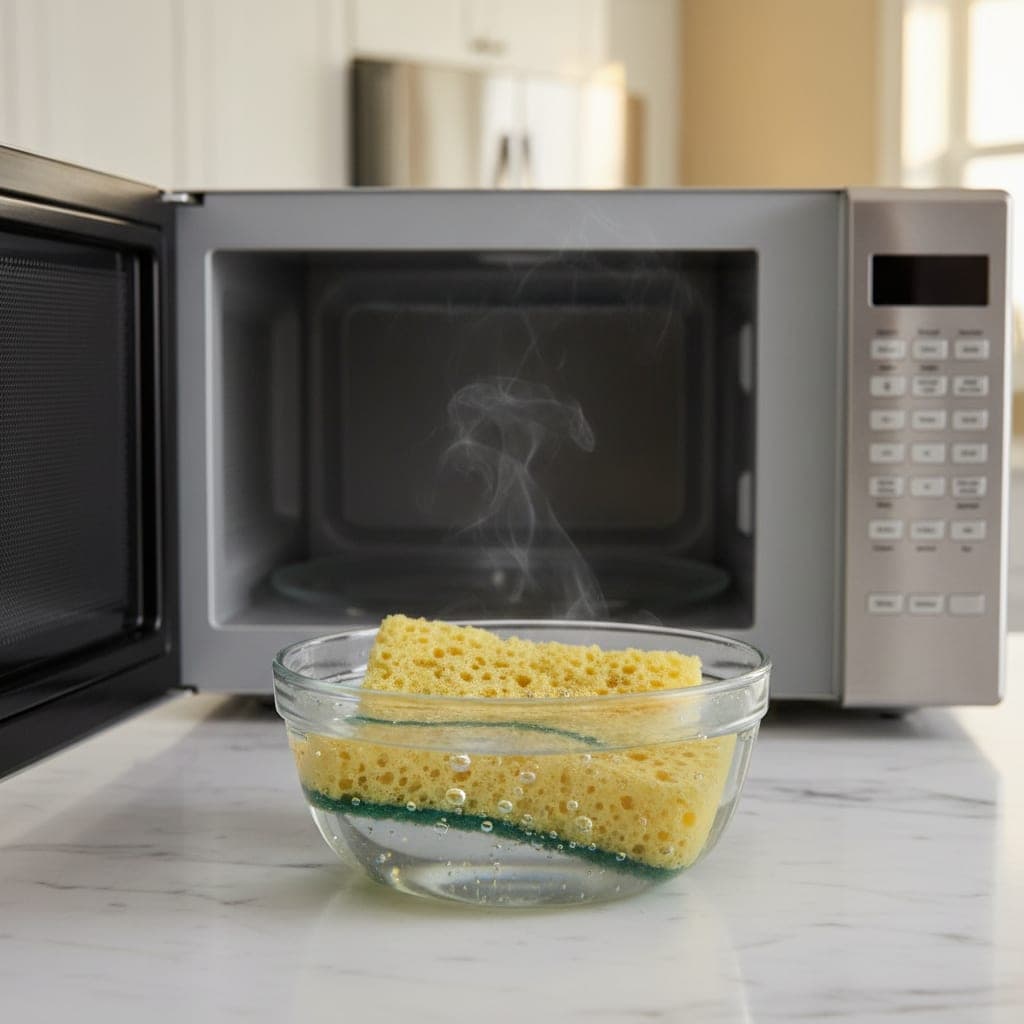
Microwaving works by heating the water held inside the sponge, which is exactly the interior the tap never reaches, and that makes it genuinely effective. It is ranked third rather than first only because of how easily it goes wrong. The sponge must be soaking wet, not damp. Saturate it, then put it in a microwave safe bowl with enough water to keep it partly submerged, because a sponge that dries out mid cycle can scorch and can catch fire. Never microwave a sponge with any metal in it, including the thin metallic scrubbing layers on some scouring pads. One to two minutes on full power is the usual recommendation, and there is no need to go longer. Then leave the door shut for a minute before opening, and lift the bowl out carefully, because both the bowl and the sponge will be near boiling and the sponge will spit hot water when squeezed. Squeeze it with tongs or leave it to cool first. People burn their hands on this step regularly, and it is entirely avoidable.
Ranked 4: a dilute bleach solution, the strongest chemical option
This is a real disinfectant rather than a folk remedy, which is why it ranks above vinegar, and it sits below the heat methods mainly because of handling and rinsing. Mix roughly half a teaspoon of regular unscented chlorine bleach into two cups of water, submerge the clean sponge, and leave it about five minutes. Wear gloves. Then rinse it thoroughly under running water and let it dry fully, because bleach residue does not belong on a sponge that will touch plates. Dilution matters in both directions: too weak does little, and neat bleach destroys the foam and is unnecessary. Two absolute rules. Never mix bleach with vinegar, and never mix it with ammonia or any product containing it, since both combinations release harmful gas. And ventilate, because a bowl of bleach solution in a small kitchen is unpleasant fast. Use the bleach route when the sponge has been used on something you want dealt with decisively, such as after raw meat, rather than as the everyday method.
Ranked 5: a vinegar soak, which is the weakest of the five
Vinegar is included because it is the method people most often try, and it deserves an honest ranking rather than quiet inclusion. Acetic acid has some antibacterial effect, and a soak in undiluted white vinegar for several minutes will reduce a smell and cut through soap film, so it is not useless. But it is not a registered disinfectant, its effect varies with concentration and contact time, and household vinegar sitting on a sponge for five minutes is a considerably weaker intervention than boiling water or a bleach solution. If vinegar is what you have, submerge the sponge completely, give it at least five minutes, then rinse and dry properly. Just do not treat it as equivalent to the methods above it, particularly after raw meat. Its best use here is as a deodorizing step on a sponge that is otherwise fine, not as sanitizing on a sponge you are worried about.
Why none of this lasts as long as you would hope
Here is the part most articles on this topic leave out. Whatever a cleaning method kills, the survivors are still in there, the sponge is still porous and damp, and food starts arriving again with the next dish. Recolonization is fast, which is why a sponge that smelled fine on Monday after a microwave can smell again by Thursday. This is not a sign the method failed. It is the nature of the object. There is also published work suggesting that repeatedly sanitizing a sponge may not reduce its total bacterial load over time as much as expected, and may shift the balance toward the organisms best able to survive being cooked. That idea deserves a proper source rather than a confident assertion, and it is flagged as needing one, but it is worth knowing that the science here is less flattering to sponge cleaning than the average cleaning article implies. The practical conclusion is the same either way: clean the sponge to keep it usable this week, and replace it on a schedule rather than trying to rescue it indefinitely.
When to stop cleaning and throw it out
A sponge is one of the cheapest things in a kitchen and the temptation to extend its life is worth resisting. Four signs mean it is finished regardless of what you do to it. It smells the moment it gets wet, which means the growth is established in the foam rather than sitting on the surface. It has torn, split or lost chunks, since damage creates deeper pockets that hold water and food. It has gone slimy or greasy, which is a film that no amount of rinsing shifts. Or it has discolored unevenly, especially dark patches inside the foam. There is also a hard rule that overrides all of these: if a sponge has been used to wipe up raw meat juices, raw egg, or the water from thawing poultry, do not attempt to rescue it. Use the bleach method at minimum, and preferably bin it. Nothing about the cost of a sponge justifies the risk of moving that around a kitchen.
Set a replacement rhythm you will actually keep
The reliable version of this whole topic is a rotation rather than a heroic cleaning regime. Buy sponges in a multipack so replacing one is never a shopping decision, and keep the spares somewhere you will see them, because a pack in the back of a cupboard is a pack that gets forgotten. A simple rhythm that works for most kitchens is to clean the sponge with a heat method every couple of days, and replace it on a fixed day of the week. Pick the day and attach it to something you already do, like the day the bins go out or the day you do a big shop. Heavy cooking, a household with young children, or anyone in the house being unwell all justify replacing more often. Food safety bodies publish guidance on intervals, so it is worth checking one rather than taking any blogger's number, including this one. Colour coding helps in a busy kitchen: one sponge for dishes, a different one for surfaces, and never the reverse.
Consider tools that dry, which sidesteps the problem
The single biggest variable in how bad a sponge gets is how much time it spends wet, so the most effective change available is switching to something that dries between uses. A dish brush with a handle does most of what a sponge does, keeps your hand out of the water, and dries within an hour because the bristles hold almost nothing. Its head can go in the dishwasher, and on many models the head is replaceable. Swedish dishcloths, the flat cellulose ones, go stiff and dry as they lose moisture, which stops growth, and they are machine washable. Silicone scrubbers hold no water at all and are the easiest to sanitize, though they are less good at wiping up fine debris. Microfiber cloths work if you have enough of them to send one to the wash daily rather than reusing a damp one. None of these are as pleasant as a sponge for scrubbing a plate, which is the honest trade off, but every one of them starts each job dry rather than damp.
Does dish soap sanitize it, and are antibacterial sponges worth buying?
Two reasonable questions that the usual advice skips over. Dish soap is a surfactant, which means its job is to surround grease and lift it off a surface so water can carry it away. That is genuinely useful and it is not disinfection. A sponge loaded with suds is a sponge that is good at removing food, not a sponge that has been sanitized, and the warm soapy water it sits in is a perfectly comfortable environment for what is living inside it. So washing up with plenty of soap does not replace any method above. It does help in one indirect way worth knowing: less food residue left in the foam means less to feed growth between uses, so rinsing the sponge properly under running water after each session genuinely slows things down. As for sponges sold as antibacterial or antimicrobial, treat the claim narrowly. Those treatments are generally aimed at controlling odor causing bacteria within the sponge material rather than making the sponge safe to use indefinitely or protecting the food you prepare. They do not change how the sponge behaves after it has wiped up raw chicken juice, and they do not remove the need for a replacement schedule. If one costs about the same as a plain sponge, there is no reason to avoid it. If it costs several times more, the money is better spent on buying plain sponges more often, which addresses the actual problem.
How you store it matters as much as how you clean it
A sponge sitting in a puddle at the bottom of the sink undoes any method above within a day, because you have returned it to the exact conditions that caused the problem. After each use, rinse the food out under running water, squeeze it as dry as your hands can manage, and put it somewhere with air reaching every side. A suction clip on the tiles, a wire rack, or a holder with an open bottom all work. What does not work is a solid cup or a closed dish, where water pools underneath and the sponge sits in it. Standing it on its edge rather than laying it flat roughly doubles the surface exposed to air. If your sponge has a scouring layer, put that side up so the softer foam is not pressed against a surface. This is the least glamorous item on the page and it makes the biggest difference to how the sponge smells three days from now.
The cross contamination rules that matter more than sterilizing
How a sponge is used decides more about kitchen hygiene than how it is cleaned. Never use the dish sponge on a surface that held raw meat, poultry or fish, or on the juices from any of them. Paper towel is the correct tool there, because it goes in the bin and carries nothing to the next surface. If a sponge does end up in that situation, treat it as contaminated. Do not use one sponge for both the sink and the plates, since the sink itself is one of the dirtier fixtures in a kitchen. Do not wipe a chopping board with the same sponge you have just used on the floor or a pet bowl. And wash your hands after handling a used sponge, particularly before touching food, which sounds obvious and is skipped constantly. A well sanitized sponge used across raw meat and then plates is worse than a slightly grubby sponge kept to dishes only.
The mistakes that make things worse rather than better
Microwaving a sponge that is not soaking wet, which is the one mistake here that can start a fire rather than merely fail. Microwaving anything with a metallic scouring layer. Squeezing a just heated sponge with a bare hand, which is the most common injury from this whole topic. Mixing bleach with vinegar or with an ammonia based cleaner, in a bowl or in sequence without rinsing. Rinsing a sponge under the hot tap and considering the job done, since that is a cosmetic clean of the outside of a porous object. Using neat bleach, which wrecks the foam without adding useful effect over a dilute solution. Trusting vinegar after raw meat. Leaving the sponge in the sink. And the quiet one that undoes everything else: keeping a sponge for a month because it still looks acceptable, when the reason to replace it was never how it looks.
A routine that puts all of this together
After every use: rinse the food out, squeeze it as dry as you can, and stand it on edge somewhere with air on all sides. After anything involving raw meat: the sponge is done, or gets the bleach treatment at minimum. Every couple of days: a heat method, whichever suits your kitchen. The dishwasher costs nothing if a load is going anyway, boiling is the most reliable, and the microwave is the fastest as long as the sponge is saturated. Weekly: replace it, on a fixed day tied to something you already do. Keep a second sponge in a different colour for surfaces and never swap them. And once a week, wipe out whatever holder the sponge lives in, since that gets a film of its own and there is little point putting a freshly boiled sponge back into a dirty cup. None of this takes meaningful time. The part that requires a decision is accepting that a sponge is a consumable rather than a tool.
Pro Tips
- Run the sponge through the dishwasher with a load you were running anyway. It is the only method here that costs you no time and no attention, and the heated dry phase is what the other methods miss.
- Use tongs on anything just heated. A boiled or microwaved sponge holds near boiling water and spits it when squeezed, and this is where people get burned.
- Buy sponges in a multipack and keep them visible. Replacement only happens on schedule if it does not require a shopping trip first.
- Keep a separate colour for surfaces and dishes. Which sponge touched what matters more to kitchen hygiene than how thoroughly either one was sanitized.
Frequently Asked Questions
Does microwaving a kitchen sponge actually work?
Yes, and the reason is that it heats the water held inside the sponge, which is the interior a rinse never reaches. It is one of the more effective things you can do at home. Two conditions are not optional. The sponge has to be soaking wet, in a bowl with some water, because a dry sponge can catch fire. And it must contain no metal, including metallic scouring layers. One to two minutes on full power is the usual recommendation. Let it stand before opening the door and handle it with tongs, since it will be near boiling and will spit hot water when squeezed.
How often should I replace a kitchen sponge?
More often than most people do, and on a schedule rather than by appearance, because the reasons to replace it are not visible. Weekly suits most kitchens, sooner with heavy cooking, young children, or anyone in the house unwell. Replace it immediately, regardless of age, if it smells as soon as it gets wet, has torn or lost pieces, feels slimy, or has been used on raw meat. Food safety bodies publish interval guidance, and that is a better source than any blog including this one. Buying in multipacks is what makes a schedule survive contact with real life.
Is a vinegar soak enough to disinfect a sponge?
It is the weakest of the common methods. Acetic acid has some antibacterial effect and vinegar will reduce a smell and cut soap film, so a soak is not pointless, but it is not a registered disinfectant and it is a much lighter intervention than boiling water, a dishwasher sanitize cycle or a dilute bleach solution. Use it to freshen a sponge that is otherwise fine. Do not rely on it after raw meat, where the honest answer is bleach at minimum or, better, a new sponge.
Why does my sponge smell again a few days after I clean it?
Because cleaning knocks the population back rather than eliminating it, and the sponge is still porous and damp with food arriving on every dish. Recolonization is quick, so a sponge can be fine on Monday and smelling by Thursday without the method having failed. What most affects how fast it returns is how wet the sponge stays between uses, which is why squeezing it out and standing it on edge with air around it matters as much as the sanitizing method. If the smell comes back within a day or two, the sponge is past saving.
Is a dish brush better than a sponge?
For hygiene, generally yes, and the reason is drying rather than anything clever. Bristles hold very little water so a brush dries within about an hour, while a sponge stays damp for most of a day, and time spent wet is the single biggest driver of growth. A brush also keeps your hand out of the dishwater, most heads go in the dishwasher, and on many models the head is replaceable. The honest trade off is that a sponge is more pleasant for wiping a plate and better at picking up fine debris. Swedish dishcloths and silicone scrubbers sit in the same category of drying fast.
How this guide was made
This Laundry & Kitchen guide was researched, written, edited, and published by Fredler Pierre-Louis. The 16 steps below are built around A microwave safe bowl, deep enough to submerge a sponge, A small saucepan and tongs, for the boiling method and White vinegar, and the quantities and dwell times come from published cleaning-chemistry and manufacturer guidance for those materials, not from a controlled trial we ran ourselves. Where a popular version of this hack does not work, or is risky on a particular surface, this 15 min guide says so.
- Checked against manufacturer and materials guidance for the surfaces named.
- Reviewed by a person for chemical safety and surface compatibility before publication.
- Written to explain why a method works, not just to list steps.
- Corrected whenever a reader reports an error or an edge case we missed.
Read our full editorial policy or learn more about the team behind TryCleaningHacks.
Related Cleaning Guides
Safety Notes
- A sponge must be soaking wet before it goes in the microwave. A dry or nearly dry sponge can scorch and can catch fire.
- Never microwave a sponge containing any metal, including the thin metallic scouring layers on some pads.
- Both the bowl and the sponge will be near boiling after heating. Let them stand a minute, then handle with tongs rather than bare hands.
- Never mix chlorine bleach with vinegar, or with ammonia or any product containing it. Both combinations release harmful gas. Rinse thoroughly between different products.
- Ventilate the kitchen when using a bleach solution, and wear gloves.
- A sponge used on raw meat, poultry, fish or thawing juices should be discarded rather than cleaned. Use paper towel for those jobs.
You might also like
How to Get Rid of Kitchen Sink Odor (10 Easy Fixes)
My kitchen sink smelled no matter how often I cleaned it until I figured out what I was actually missing. The fix wasn't a new product; it was addressing three different sources at once. Here's what finally worked and the one mistake that kept the smell coming back.
How to Clean a Microwave Inside and Out (12 Methods)
Almost nobody needs to scrub a microwave. Dried food is mostly water that has left, and steam puts enough of it back that the mess wipes away with a cloth, which is why the order of operations matters more than the product. There is also a part of the inside you should never scrub, a filter on over the range models that most owners have never removed, and a ceiling that looks fine until you point a flashlight at it. Here are twelve methods for the inside, the outside and the smell, with what each one is actually for and where it falls short.
How to Clean Stainless Steel Appliances Without Streaks (9 Methods)
Stainless steel appliances streak for one reason that almost every cleaning attempt gets wrong, and it has nothing to do with which product you buy. Stainless has a directional grain, and wiping across it drags residue into the grooves instead of out of them. Here are nine methods ranked for built-up fingerprints and kitchen grease, and the technique that decides whether any of them work.