

How to Clean a Wooden Cutting Board
My wooden cutting board had knife grooves that smelled like old garlic and a corner stain I had given up on. After testing every method I could find across three different boards over a month, I found a cleaning sequence that works genuinely well and a conditioning routine that keeps wood boards looking new for years. The mistakes most people make are the ones that crack and warp boards permanently.
Jump to a section
- What you'll need
- Step-by-step
- Why wooden cutting boards need different care than plastic boards
- The salt and lemon scrub for daily freshening and deodorizing
- Proper everyday dish soap washing technique
- Deodorizing after garlic, onion, and fish
- Hydrogen peroxide treatment for bacteria in knife grooves
- Removing deep stains with baking soda paste
- Pro tips
- FAQ
What You'll Need
Step-by-Step Instructions
Why wooden cutting boards need different care than plastic boards
Wooden cutting boards are fundamentally different from plastic boards in how they interact with water, cleaning agents, and bacteria. Wood is a porous material that swells when it absorbs water and contracts as it dries, which is why wooden boards warp, crack, and split when exposed to excess moisture repeatedly. Unlike plastic, wood cannot be put in a dishwasher or submerged in water without damaging the board's structure. However, wood has a natural advantage over plastic in food safety: certain hardwoods contain antimicrobial compounds in their grain structure that inhibit bacterial growth at the surface and within the pores to a meaningful degree. Studies comparing plastic and wood boards have found that bacteria introduced onto wooden board surfaces die off more rapidly than on plastic, partly because the wood fibers draw bacteria inward away from the surface where they dehydrate and die in the dry interior. This natural property is worth preserving, which means using gentle cleaning agents that do not strip or denature the wood's natural compounds. The goal of cleaning a wooden cutting board is not to sanitize it the way you would sanitize a hard nonporous surface, but to remove food debris, neutralize odors, and periodically address bacteria in knife grooves where food particles compress and accumulate.
The salt and lemon scrub for daily freshening and deodorizing
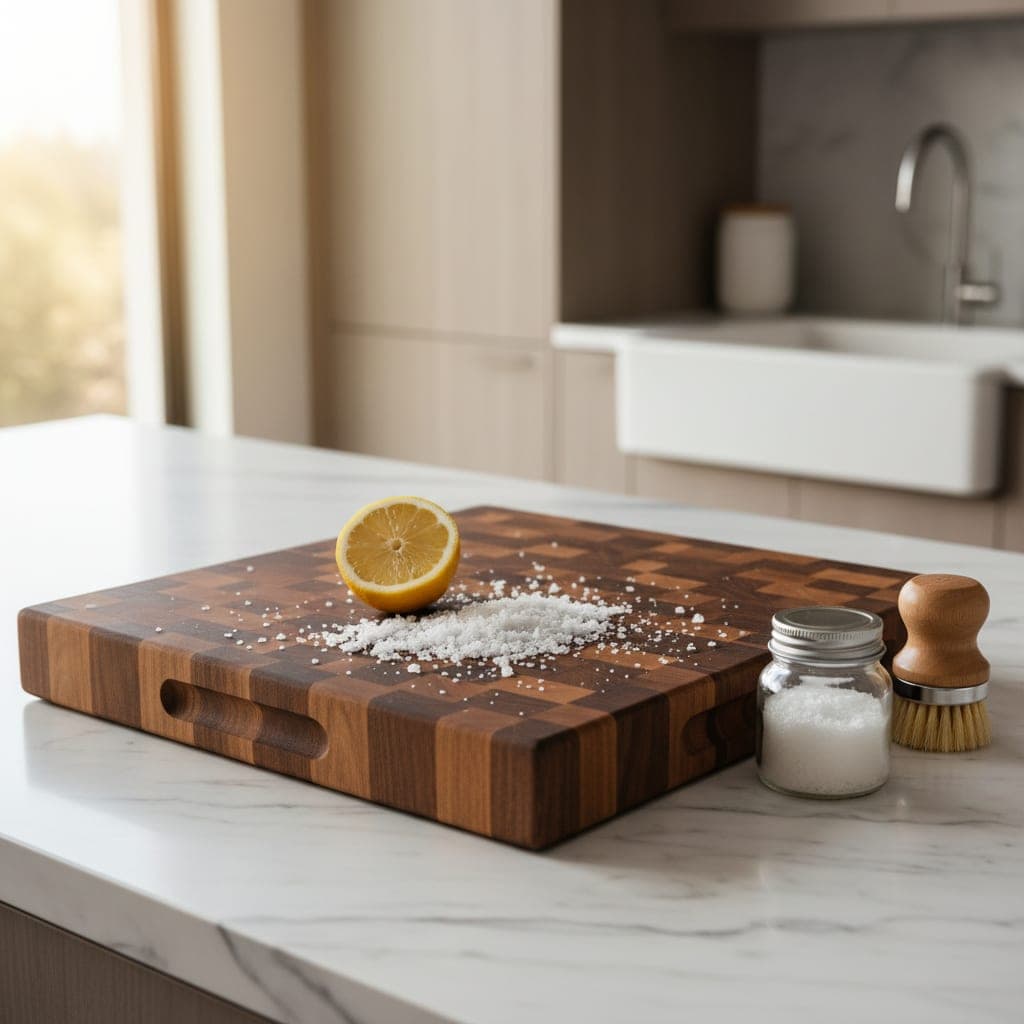
The salt and lemon scrub is one of the oldest and most effective methods for maintaining a wooden cutting board between deeper cleaning sessions, and it works through two complementary mechanisms. Coarse kosher salt acts as a gentle mechanical abrasive that lifts food residue, stray fibers, and superficial stains from the wood grain without scratching the surface the way commercial abrasive cleaners would. The citric acid in lemon juice simultaneously breaks down staining compounds, kills surface bacteria, and neutralizes the odor molecules from garlic, onion, raw fish, and meat that absorb into the top layer of the wood. Sprinkle a generous layer of coarse kosher salt across the entire surface of the board. Cut a lemon in half and use the cut face of the lemon as a scrubbing tool, pressing it firmly and scrubbing in circular motions across the entire board surface. The salt crystals and lemon juice combine into an abrasive, acidic slurry that penetrates slightly into the grain. Continue scrubbing for two to three minutes, paying extra attention to dark stained areas and knife groove zones where odor and residue concentrate. Let the slurry sit on the board for five minutes, then scrape it off with a bench scraper or the edge of a clean butter knife and rinse quickly under cold running water before wiping dry immediately. This method is safe to perform every day and takes under five minutes.
Proper everyday dish soap washing technique
Contrary to what you may have heard, mild dish soap is safe to use on wooden cutting boards for everyday cleaning as long as you follow the correct technique. The myth that soap ruins wood boards comes from older, harsher soaps that contained lye and other alkalis that could strip wood finishes and break down the fiber structure. Modern dish soap at the concentration used for dishwashing is mild enough to remove food residue from wood without damaging the grain. Apply a small amount of dish soap directly to the board surface or to a damp sponge. Scrub the board under cold or lukewarm water, never hot water, for 30 to 60 seconds. Use a soft brush for knife grooves where a flat sponge cannot make contact with the deepest parts of the scoring. Rinse the board thoroughly under running water to remove all soap residue, because soap left in the grain creates a film that attracts new food particles and eventually leads to a rancid smell. The critical step is what happens immediately after washing: stand the board on its edge or prop it at an angle against a wall or cabinet to allow airflow across both faces simultaneously. Never lay a wet board flat. Flat drying traps moisture against the bottom face and around the edges, which is the primary cause of warping in wooden boards. Drying vertically allows moisture to evaporate evenly from all surfaces and prevents the differential shrinkage that causes boards to bow.
Deodorizing after garlic, onion, and fish
Garlic, onion, raw fish, and certain spices leave behind volatile sulfur compounds and trimethylamine compounds that penetrate into the top layer of wood fibers and resist simple soap washing. These are the odors you detect the next time you pick up the board even days after washing it. The baking soda paste method is the most effective targeted deodorizer for wooden boards because baking soda is alkaline and neutralizes both the acidic citrus compounds from garlic and the alkaline trimethylamine compounds from fish in a single treatment. Mix three tablespoons of baking soda with enough water to form a thick paste and spread it across the surface of the board, pressing it gently into the knife grooves with a soft brush. Let the paste sit for five minutes, then scrub gently and rinse under cold water. For persistent fish odor that survives a single baking soda treatment, follow with the salt and lemon scrub immediately after rinsing off the baking soda. The two-step combination of neutralization with baking soda followed by acidic deodorizing with lemon reaches across the full pH range of odor compounds and eliminates both types in a single session. For boards used heavily with fish, doing this double treatment every time fish contacts the board prevents the cumulative buildup that eventually becomes very difficult to eliminate.
Hydrogen peroxide treatment for bacteria in knife grooves
Knife grooves are the most significant food safety concern on a wooden cutting board because they create protected channels where food particles compact and bacteria can survive soap washing by hiding in the depth of the cut. Standard bristle brushes often cannot reach the very bottom of deep grooves, and the mechanical action of scrubbing is less effective in these narrow spaces. Hydrogen peroxide at the standard 3 percent concentration available in any drugstore or grocery store is a safe and effective antibacterial treatment for wooden boards precisely because it works as a liquid that flows into groove spaces rather than as a mechanical abrasive. After washing and drying the board, pour a tablespoon of hydrogen peroxide directly onto the board surface and use a clean cloth to spread it into every groove and across the entire cutting surface. Let it sit for five minutes. You may see slight fizzing in areas where organic residue remains, which indicates the peroxide is reacting with the bacteria and organic matter in those grooves. Wipe the surface clean with a damp cloth and allow to air dry. Hydrogen peroxide is safe for all types of wood and does not bleach or discolor natural wood tones at the 3 percent concentration. It evaporates completely without leaving chemical residue, making it food-safe immediately after the brief air dry period. Perform this treatment weekly on boards used for raw poultry and monthly on boards used for produce and cooked food.
Removing deep stains with baking soda paste
Stubborn stains from berries, red wine, beets, curry, and dark sauces can penetrate the top millimeter or so of the wood surface where soap cannot reach them. These stains are not a food safety concern but they are unsightly and they often carry a faint residual odor. Baking soda paste applied with sustained contact time is the most effective stain removal treatment that is safe for wood. Mix a thicker paste than you would use for deodorizing, approximately three parts baking soda to one part water, and apply a generous layer directly to the stained area. Cover the paste with a damp cloth and leave it in contact with the stain for 15 to 30 minutes. The mild alkalinity of the baking soda breaks down many staining compounds by disrupting their molecular structure, while the sustained contact time allows it to work deeper into the grain than a quick scrub would. After the dwell time, scrub with a soft brush and rinse. For stains that do not fully yield to a single baking soda treatment, lightly sand the stained area with fine 220-grit sandpaper in the direction of the wood grain. A very light pass removes the top layer of stained wood fiber and is the only truly permanent stain removal method for deep penetrations. After sanding, re-season the sanded area with mineral oil before using the board again, as sanding removes the oil conditioning that protects that section of wood.
Conditioning with food-grade mineral oil to preserve the wood
Conditioning a wooden cutting board with food-grade mineral oil is the most important maintenance step that most people skip and the one that determines whether a board lasts five years or twenty years. Wood loses moisture over time through evaporation, and as the wood fibers dry out they become brittle, crack along the grain, and develop deep splits that are not just unsightly but are impossible to clean effectively. Food-grade mineral oil replenishes the moisture content of the wood, fills the pores to prevent future absorption of food juices and bacteria, and creates a barrier against the rapid moisture cycling from washing and drying that causes warping. Apply a generous coat of food-grade mineral oil to all surfaces of the board including the bottom, the sides, and the edges, using a clean cloth. Let the oil soak in for a minimum of 6 hours, or overnight, before wiping off the excess. Repeat this application three times in succession for a new board or a board that has been allowed to dry out, as three sequential applications are necessary to fully saturate dry wood fiber. For maintenance, oil the board once a month if it is used daily, or whenever the wood surface looks dry, light in color, or rough to the touch compared to a freshly oiled surface. Never use olive oil, vegetable oil, coconut oil, or other food-based oils for this purpose because they are not fully stable and will turn rancid inside the wood, permanently contaminating it with a foul smell that no amount of cleaning removes.
How to dry a wooden cutting board without warping
Warping is the most common damage wooden cutting boards sustain, and it is almost entirely preventable with the correct drying technique. Warping occurs when one face of the board dries faster than the other, causing the drying side to contract while the moist side retains its expanded dimensions. The differential shrinkage creates a curve that, once established, is very difficult to reverse. The correct drying method is to stand the board on its edge or long side so that both flat faces are exposed to open air simultaneously and dry at the same rate. If your board has a hanging hole, hang it vertically after washing. When standing on edge is not practical, prop the board at a 45 degree angle against a wall with both faces exposed. Never lay a wet board flat on the counter and never lean it with one face against a wall or cabinet surface, as both positions restrict airflow to one face and cause differential drying. For boards that have already developed a slight warp, the reversal method is to place the board concave side down on a damp towel for 30 minutes so the concave face absorbs moisture and expands slightly, then stand it on its edge to dry evenly. Repeat this process over several days and the warp will correct progressively. Prevention is far easier than correction, and a simple habit of always standing the board on its edge after washing eliminates warping as a concern entirely.
Sanitizing without submerging the board in water
Submerging a wooden cutting board in water, whether in a sink full of soapy water or in a water-filled basin, is one of the most damaging things you can do to the board. Full submersion forces water into every pore and fiber of the wood simultaneously and on all faces at once, causing extreme swelling that overstresses the grain structure and almost always results in cracking or severe warping when the board subsequently dries. The good news is that you do not need to submerge a wooden board to sanitize it effectively. The combination of the hydrogen peroxide treatment described above, the salt and lemon scrub, and regular soap washing keeps the bacterial load on a wooden cutting board at safe levels for all normal household food preparation. For an additional level of sanitization when preparing raw poultry or other high-risk proteins, spray the surface of the clean dry board with undiluted white vinegar, let it sit for three minutes, then wipe clean with a damp cloth and allow to air dry. The acetic acid in undiluted vinegar is an effective antimicrobial at this contact time and concentration without requiring water immersion. This spray sanitizing method is the professional kitchen approach to maintaining wooden boards and is safer and more effective than attempting to immerse the board.
When to replace rather than continue cleaning
A well-maintained wooden cutting board can last 10 to 20 years with proper care, but there are specific conditions that indicate a board has reached the end of its safe useful life and should be replaced rather than cleaned more aggressively. Deep cracks that run through the full thickness of the board create channels that are impossible to clean and sanitize regardless of the method used. Food and bacteria that enter these through-cracks cannot be reached by surface cleaning agents and will contaminate food prepared on the board. A board that has cracked fully through in any area should be retired from food preparation immediately. Similarly, boards that have developed a persistent sour or rancid smell that does not respond to salt and lemon scrub, hydrogen peroxide treatment, or baking soda deodorizing have absorbed contamination too deeply into the grain to recover. This is almost always the result of being washed less frequently than it needed, having leftover wet food scraps left on it for extended periods, or being oiled with a food-based oil that subsequently went rancid inside the wood. Surface deep staining that is purely cosmetic is not a reason to replace a board. A board that looks dark and worn but has no through-cracks and no persistent smell is structurally sound and safely usable with continued maintenance.
What worked best over months of regular board use
After maintaining three different wooden boards through a month of intensive testing with daily use including raw chicken, fish, garlic, onions, and berries, the methods that produced consistently excellent results were the salt and lemon daily scrub, the hydrogen peroxide weekly antibacterial treatment, and the monthly mineral oil conditioning. These three practices together kept all three boards odor-free, stain-controlled, and structurally sound with no warping or cracking throughout the test period. The biggest single improvement in daily use was switching from flat counter drying to vertical edge drying, which eliminated the minor warping that had developed on my oldest board and prevented it from recurring. The baking soda paste is the most impressive stain remover for berry and turmeric stains, outperforming every other method here. One caution: white vinegar used as a daily sanitizer will dull a board's finish over weeks of repeated use, which is why I now use it only as an occasional spray sanitizer rather than a regular daily wash. The hydrogen peroxide approach is softer on the wood surface and equally effective for the weekly antibacterial treatment, making it my preferred tool for that step.
Mistakes that warp, crack, or permanently contaminate wooden boards
Mistake one: putting a wooden cutting board in the dishwasher. The combination of detergent, sustained high heat, and full water saturation in a dishwasher cycle is catastrophic for wooden boards. Most boards that go through a full dishwasher cycle crack, warp significantly, or split at the glue lines within one to three cycles. This single mistake permanently damages boards that would otherwise last many years. Mistake two: using olive oil, vegetable oil, or coconut oil as a conditioning treatment. All plant-based cooking oils are unstable at household temperatures and will turn rancid inside the wood within weeks, producing a smell that is permanent and impossible to remove. Only food-grade mineral oil or a beeswax board cream designed specifically for wooden cutting boards should be used for conditioning. Mistake three: leaving a wet board flat on the counter. The bottom face cannot dry properly in this position and the sustained moisture on that face causes warping within days of regular washing. Always stand on edge or hang after washing. Mistake four: using bleach on a wooden board. Bleach denatures the wood's natural antimicrobial compounds, bleaches the wood unevenly causing permanent discoloration, dries the grain aggressively, and leaves chemical residue that is not food-safe even after rinsing, as bleach soaks into the porous wood rather than rinsing away completely from the surface the way it would from a nonporous tile or countertop.
Pro Tips
- Stand the board on its edge to dry after every wash. This single habit prevents warping entirely by allowing both faces to dry at the same rate.
- Oil with food-grade mineral oil once a month. When the dry wood surface looks lighter in color than usual, that is the sign it needs conditioning before the next wash.
- Use hydrogen peroxide weekly on boards used for raw meat. Pour it directly onto the clean dry surface, let it sit for five minutes, and wipe clean. It sanitizes knife grooves that a brush cannot reach.
- Wood is not the only kitchen tool that hates the dishwasher, cast iron does too. For rescuing a rusty or sticky pan, see how to deep clean a cast iron skillet and re-season it properly.
Frequently Asked Questions
How do you clean a wooden cutting board naturally?
Sprinkle coarse kosher salt across the surface, use the cut face of a lemon to scrub the entire board in circular motions for two to three minutes, then scrape off the slurry and rinse quickly under cold water. For deeper cleaning, wash with a small amount of mild dish soap using a soft brush, rinse thoroughly, and stand on edge to dry.
How do you get the smell out of a wooden cutting board?
For garlic and onion odor, apply a baking soda paste, let sit for five minutes, scrub, and rinse. For fish odor, combine baking soda neutralizing followed immediately by a salt and lemon scrub. For persistent smells, hydrogen peroxide poured onto the clean dry surface and left for five minutes reaches bacteria in knife grooves where surface cleaning agents cannot.
Can you use dish soap on a wooden cutting board?
Yes, modern mild dish soap is safe for wooden cutting boards when used correctly. Use a small amount, scrub with a soft brush rather than a harsh sponge, rinse thoroughly, and dry the board on its edge rather than flat. The key precautions are avoiding hot water and never submerging the board, as sustained water saturation causes warping and cracking.
How often should you oil a wooden cutting board?
Oil a new board three times in succession with food-grade mineral oil before first use to saturate the dry wood. For an established board in regular daily use, oil once a month or whenever the wood surface looks noticeably lighter and drier than usual. Boards used less frequently may only need oiling every two to three months.
Why does my wooden cutting board smell even after washing?
Persistent odor after washing usually means volatile compounds from garlic, onion, or fish have absorbed into the wood fiber below the surface layer that soap can reach. The most effective remedy is the baking soda paste deodorizer, which neutralizes the odor molecules at a chemical level. For knife groove odor that resists surface cleaning, the hydrogen peroxide treatment reaches the bacteria in those grooves that are the source of the smell.
How this guide was made
This Deep Clean guide was researched, written, edited, and published by Fredler Pierre-Louis. The 12 steps below are built around Coarse kosher salt, Lemon and Dish soap (Dawn), and the quantities and dwell times come from published cleaning-chemistry and manufacturer guidance for those materials, not from a controlled trial we ran ourselves. Where a popular version of this hack does not work, or is risky on a particular surface, this 11 min guide says so.
- Checked against manufacturer and materials guidance for the surfaces named.
- Reviewed by a person for chemical safety and surface compatibility before publication.
- Written to explain why a method works, not just to list steps.
- Corrected whenever a reader reports an error or an edge case we missed.
Read our full editorial policy or learn more about the team behind TryCleaningHacks.
Related Cleaning Guides
Safety Notes
- Never put a wooden cutting board in the dishwasher. The sustained heat and full water saturation cause cracking, warping, and permanent structural damage within one to three cycles.
- Do not use bleach on wooden cutting boards. Bleach is absorbed into the porous wood grain and cannot be fully rinsed out, leaving chemical residue on a food contact surface and permanently damaging the wood's natural antimicrobial properties.
- Only use food-grade mineral oil for board conditioning. Olive oil, coconut oil, and other plant-based oils turn rancid inside the wood grain and permanently contaminate the board with a smell that no amount of cleaning removes.
You might also like
7 Deep Cleaning Tricks That Save Hours Every Week
Most of the time spent cleaning a bathroom is spent waiting or backtracking, not scrubbing. Spraying one surface, waiting for it, wiping it, then starting the next one means you pay every dwell time separately. Batching those dwell times so every cleaner works at once is the single change that cuts the job roughly in half. None of this involves a gadget or a miracle spray, just the order you work in and where you stop wasting motion.
How to Deep Clean a Shower (10 Proven Methods)
I deep cleaned the same shower twice in one week once with my old routine and once with these ten methods applied in the right sequence. The difference wasn't even close. Here's what changed and the daily habit that eliminated most of my scrubbing for good.
30 Cleaning Myths You Need to Stop Believing
I believed most of these myths for years, and two of them left permanent marks on surfaces in my own house. This is the honest version of what I got wrong, why the popular advice fails, and the two safety myths that actually send people to the emergency room. I have kept the failures in here on purpose, because the mistakes taught me more than the wins did, and a myth is only dangerous while you still trust it.