

How to Declutter Your Room in One Afternoon (Without Burning Out)
There is a chair in the room, and it has not been a chair in months. It is where clean laundry goes to wait. The nightstand has three water glasses on it, the closet holds clothes in two sizes you no longer wear, and every time you think about fixing it the job feels too big to start on a Saturday. It is not too big. A bedroom is mostly one afternoon of sorting plus one habit afterward. What follows is the order to work in, the decision rules that stop you stalling on individual objects, the four categories that eat the most time, and the step most people skip, which is the one that decides whether the room stays clear.
Jump to a section
- What you'll need
- Step-by-step
- Photograph the room from the doorway, then judge the photo instead of the room
- Four baskets, no Maybe pile, and one box you can seal
- Set a 90 minute timer and stop when it rings
- Work surfaces first, drawers second, closet last
- Decide in about three seconds
- Clothes: the twelve month rule and the backward hanger
- Pro tips
- FAQ
What You'll Need
Step-by-Step Instructions
Photograph the room from the doorway, then judge the photo instead of the room
Before you move anything, stand in the doorway and take one wide phone photo. Not just for the comparison later, though that helps. It works as a diagnostic. Your eyes stop registering mess you walk past every day, so a room you live in reads as normal even when it is not. A photo flattens the space to two dimensions and strips out that familiarity, and the piles jump out in a way they do not in person. Look at the photo and you will spot the three or four spots doing most of the damage. Usually they are horizontal surfaces: the chair, the nightstand, the dresser top, the floor along one wall. Those are your priorities, and they are often not the ones you would have picked standing in the room. Take a second photo from the opposite corner if the room is long or L shaped, because one angle tends to hide whatever is behind the door.
Four baskets, no Maybe pile, and one box you can seal
Label four containers Keep, Donate, Trash, and Relocate. Relocate is for things that belong in the house but not in this room, which is most of what collects in a bedroom: mugs, tools, mail, a phone charger that lives in the kitchen. The fifth container is different. Seal it, write the date on the side, and use it only for items you genuinely cannot call. If you have not gone looking for anything in it after a month, donate it unopened. The important part is that there is no Maybe basket sitting in the room. A Maybe pile is your original clutter with a label on it, and it tends to end up back on the dresser by the weekend. Baskets beat bags for this because you can see into them, and seeing the Donate basket fill up is a large part of what keeps the session moving. If the floor has no clear space, strip the bed and sort on the mattress. You have to remake it anyway.
Set a 90 minute timer and stop when it rings
Sorting is a long run of small decisions, and decision making gets sloppy well before your body gets tired. Somewhere past the hour and a half mark most people start doing one of two things: keeping everything because deciding has become exhausting, or dumping things they will later miss. Both turn a declutter into a regret. The timer also makes it much easier to begin, because you are agreeing to 90 minutes rather than to an open ended afternoon that might swallow the whole day. If the room has been accumulating for years, plan two sessions on back to back days instead of one long push. Stopping at the timer with the closet untouched is a normal outcome, not a failure. Put on a podcast or an album while you work. Quiet makes every decision feel heavier than it is, and an audio anchor keeps your hands moving through the stretch where objects start triggering memories.
Work surfaces first, drawers second, closet last
Order does a lot of the work here. Flat surfaces are what make a room read as cluttered, so clearing them buys the biggest visible change for the least effort, and that visible change is what keeps you going when the interesting part is over. Clear the nightstand, the dresser top, the desk, and the chair, dropping every item straight into a basket. Do not walk anything to its home yet. Then drawers, one at a time, dumped out completely so you are sorting a pile rather than picking through a full drawer. Emptying the drawer matters more than it sounds: things at the back of a full drawer are invisible, and invisible items never get decided on. Closet last, always. Clothing carries more second guessing per item than anything else in the room, so opening it in the first 20 minutes spends your sharpest decisions on the hardest category. An hour of sorting first makes you noticeably faster at it.
Decide in about three seconds
Pick something up, name a basket, move on. Three seconds is not a magic number. The point is that your first read on an object is usually right, and the time after that mostly goes into building a case for keeping something you do not actually want. Most of what sits in a cluttered bedroom is not a hard call: dead pens, cords for devices you no longer own, a shirt you stopped liking two years ago, a water glass from last week. The genuinely difficult items are a small share of the total, and those go in the sealed box so they stop blocking the other two hundred decisions. Never set an undecided item back down where it was. Out of your hand and undecided means it goes in the box. If you notice yourself narrating a justification out loud, that is the tell that the item is going in the box rather than back on the shelf.
Clothes: the twelve month rule and the backward hanger
Start with anything unworn in the last twelve months. Seasonal pieces are exempt, but only if you truly wear them every winter or summer. A dress worn once for a wedding five years ago is not seasonal, it is a keepsake, and it belongs stored with keepsakes instead of taking prime hanging space. Two categories deserve their own decision. Aspirational sizes, in either direction, are the single biggest source of closet volume in most rooms, and keeping them is a bet that costs you space every day until it pays off. Store them somewhere other than the daily closet if you cannot let them go yet. Then there are the items that are fine but never chosen, which usually means something specific is wrong: it itches, it needs ironing, the neckline sits oddly. Name the reason and the decision gets easy. If you are unsure what you actually wear, turn every hanger backward today and rehang forward after each wear. Whatever is still backward in six months has answered the question.
Count duplicates, then keep the best one
For everything that is not clothing, count duplicates. Three opened lip balms, five phone chargers, a drawer of hotel pens, four pairs of nail scissors that all live in different rooms. Keep the best one or two and clear the rest. Duplicates are the easiest volume you will ever remove, because nobody is sentimental about the fourth one, and the count itself does the arguing for you. The exception worth making is anything where having a spare in a second location genuinely saves you time, like a phone charger by the bed and another at the desk. That is a system, not a duplicate. What is not a system is six chargers in a drawer for two devices.
Paper is where the afternoon usually dies
Paper deserves its own pass because it is the one category that cannot be sorted at three seconds an item, and trying to do it inside the main sweep is what turns a 90 minute session into a whole weekend. Do not read anything during the sort. Every piece of paper goes into one box, unsorted, and that box gets its own separate half hour on a different day. When you do sit down with it, three piles: shred, file, act. Anything with an account number, a full date of birth, or a signature goes to shred rather than the recycling. Keep tax paperwork and anything supporting a tax return for as long as your country requires, which is longer than most people assume, so check rather than guess. Receipts for anything under warranty stay until the warranty expires. Almost everything else, and this is the large majority of a paper pile, is a statement or a notice that exists online already and can go. Manuals for appliances you still own are the classic thing people keep and the classic thing that is a PDF search away.
Sentimental items: photograph, then decide
Sentimental objects are not a decluttering problem, they are a grief and memory problem wearing a decluttering costume, which is why the three second rule does not apply to them and why forcing it makes people either keep everything or throw out something they mourn. Give them a different rule. Photograph the object, then decide. A photo keeps the memory available without the object taking up shelf space for the next decade, and for a surprising number of things that is genuinely enough. What the photo does not solve is the item you can still smell or hold, which is a different kind of keeping, and those deserve to stay. The practical move is to cap the volume rather than judge each piece: one box, a real box with a lid, and the rule is that the box has to close. Sorting inside a fixed container turns an impossible emotional decision into a comparison between two specific things, which is a decision people can actually make.
Gifts you do not like, and the guilt attached to them
Separate the object from the gesture. A gift did its job at the moment it was given, and keeping it in a drawer adds nothing to that transaction. Nobody who gave you something wanted it to become a low grade obligation sitting in your room for years. If guilt is the only reason it is still there, photograph it and donate it. If the giver visits often and would notice its absence, either box it with the keepsakes or accept the small awkwardness once rather than the storage cost forever. Items inherited after a death are a genuinely different case. Do not sort those in the same session as the dead pens and the hotel pens, and do not sort them under a timer. That work is tiring in a way unrelated to the lifting, and fatigue pushes people toward both keeping too much and letting go of things they later want back.
The two dead zones: under the bed and the top shelf
Every bedroom has two places where things go to be forgotten, and both need pulling out rather than glancing at. Under the bed is where seasonal items, luggage, and whatever got shoved out of sight before guests arrived all end up, and because you never see it, you have no memory of what is down there. Pull all of it out onto the floor at once. Anything you cannot name before you look at it is a strong donate candidate. The top shelf of the closet is the same problem at eye level plus a step stool: it holds the boxes that came with electronics, gift bags saved for reuse, and at least one thing that belongs to someone who moved out. Both zones are worth doing precisely because clearing them adds usable storage back to the room, which is what makes the remaining keep pile fit without buying anything.
Cables, chargers, and the electronics drawer
Cables are their own species of clutter because they are individually plausible and collectively absurd. Lay them all out on the bed and match each one to a device you currently own and use. Anything you cannot match goes, and that will be most of them. Old phones are worth separating out rather than binning: they hold accounts and photos, so wipe them before they leave the house, and take them to electronics recycling rather than the curbside bin, since batteries do not belong in household waste. The genuinely useful keeps are one spare charging cable per connector type you actually own, and that is it. For the ones you keep, a cut down shoebox in the drawer stops them knitting themselves back into a ball within a fortnight.
Cosmetics and toiletries have expiry dates you have never looked at
This category clears faster than any other once you know what to look for, because a lot of it is simply past it. Mascara is the shortest lived thing in most bedrooms and is worth replacing on schedule for eye safety rather than performance. Sunscreen has a printed expiry and stops protecting properly past it, which matters more than the shelf space. Anything that has separated, changed colour, gone gritty, or smells different from when you bought it is finished regardless of the date on the box. Most products carry a small open jar symbol with a number in it, which is the months of use after opening, and it is the number people never read. Half used bottles of something you did not like are the other easy win here. You are not going to start liking it.
Do not buy storage bins yet, and maybe not at all
The instinct afterward is to order drawer organizers and matching bins. Buy them now and you will size them to the volume you currently own, which quietly commits you to keeping all of it. Containers do not reduce clutter. They make the same amount of stuff look deliberate, which is why an organized closet can still be a completely full one, and why buying storage before sorting is the most common way a declutter turns into a shopping trip that changes nothing. Sort first, live with what remains for a week or two, then buy for that volume if anything is still needed. For drawers, cardboard usually does the job free. Cut shoeboxes down to roughly half an inch shorter than the drawer is deep and set them in as dividers for socks, cables, or cosmetics. Not pretty, but they sit inside a closed drawer, and they cost nothing while you find out whether the layout actually works.
Where the donate pile actually goes
Assuming a charity shop will take everything is how a donate bag becomes landfill with extra steps. Textiles that arrive damp, stained, or torn generally cannot be sold and cost the shop money to dispose of, so wash what you are donating and be honest about anything damaged. Most shops cannot take opened toiletries, used pillows and duvets, car seats, or old electrical goods without testing, and rules vary by area, so a two minute look at their website saves a wasted trip. Things that genuinely are worn out have better routes: textile recycling banks take fabric that is past wearing, and many larger clothing retailers run take back bins. Selling is worth it for a small number of categories, mainly current electronics, brand name items in good condition, and furniture, and it is not worth it for ordinary clothes, where the listing time exceeds the return. If you do not have a car, the local collection services that pick up bagged donations from your door solve the biggest single reason donate bags never leave the house.
Get the boxes out of the house the same day
This is the step that decides whether the afternoon holds. Trash goes to the outdoor bin before dinner. Donations go in the car trunk, not the garage and not beside the front door, with a phone reminder to drop them within three days. A bag that sleeps indoors tends to get opened, and things drift back within a day or two. Walk the Relocate basket through the house instead of parking it in the hallway, and resist the temptation to start tidying the rooms you pass through, which is a well worn way to lose an hour and finish neither room. Keep is the only basket that returns to the room, and only after the surfaces are clean. That sequence matters: choosing a spot for each thing turns a fair number of Keep items into donations, because keeping something in the abstract is easy and finding it a home is not.
Clean the bare surfaces while you have the chance
An empty room is the only time you can clean one properly. Wipe the dresser top and nightstand, run a damp cloth through the empty drawers, pull the bed out and vacuum under it, and get the baseboards that have been behind a pile since spring. Door handles, light switches, and the top edge of the door frame hold more dust than people expect. Twenty minutes covers an average bedroom. If the mattress has not been touched in six months, this is the moment for it, since it is already stripped and pulled away from the wall. The reason this step is worth the extra twenty minutes is motivational rather than hygienic: a cleared room that is still dingy does not feel new, and a room that does not feel new is a room you stop maintaining within the month.
Put back three things or fewer per surface
When things go back, go sparingly: three items or fewer per surface. A nightstand with a lamp, a book, and a glass reads as calm. The same nightstand with eight tidy items reads as cluttered even though nothing is out of place, because the eye counts objects rather than assessing tidiness. Everything else goes in a drawer. Give the things you use daily the easiest spot to reach, and put anything used weekly or less somewhere slightly inconvenient, because convenience is a finite resource and spending it on rarely used objects is how surfaces refill. This styling pass is the cheapest visual upgrade in the room and it takes about five minutes.
One in, one out, plus five minutes a night
A room refills gradually, a few purchases at a time, which is exactly why it sneaks up on you. One rule covers it: for every new item that comes in, one leaves. New shirt, old shirt goes. This is not about owning less on principle, it is about holding the total steady so you never need another 90 minute session. Then a five minute reset before bed. Set a timer, put back whatever landed on a flat surface that day, throw out the trash, stop when it rings. Anything bigger goes on a weekend list rather than turning the nightly reset into a chore you start skipping. The reset works because it runs daily, not because it is thorough, so protect the five minute limit even on the nights when the room could use twenty.
When the room is not only yours
Sorting someone else's belongings is the fastest way to turn a good afternoon into an argument, and it does not matter how obvious you find it that the item should go. If the room is shared, sort only what is yours and put their things in a basket for them to handle. The same applies to a child's room: doing it for them while they are out produces a tidy room and a child who trusts you slightly less with their possessions. Sorting alongside them takes longer and holds better, and giving them a fixed container to fill rather than asking them to name things to lose turns it into a game with an achievable end. For a partner, the honest version is to declutter your own share first. A visibly clearer half of the room does more to prompt someone than any conversation about it will.
If you keep stalling, shrink the unit of work
Some rooms do not respond to the 90 minute plan, and that is usually a sign the unit of work is too big rather than a sign of a character flaw. Shrink it. One drawer. One shelf. The top of the nightstand and nothing else. A single ten minute session that finishes is worth more than a planned afternoon that never starts, and it gives you a real sense of your own sorting pace, which makes the bigger session much less daunting to schedule. Two adjustments help when starting is the hard part: work with someone else in the room, even if they are doing their own task, and start with the trash bag only. Walking the room and binning nothing but actual rubbish is a decision free pass that visibly changes the space and gets you moving. If a specific pile has defeated you more than twice, it is usually not the pile. It is that the pile has no destination, so decide where those things go before touching them again.
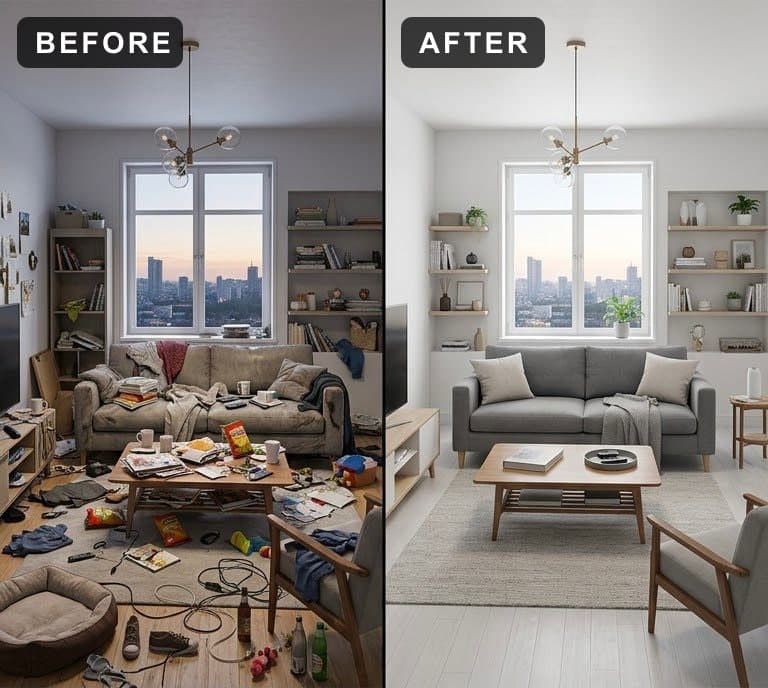
What the difference looks like
Pro Tips
- Write the date on the sealed box and set a calendar reminder for 30 days out. Without the reminder it quietly becomes permanent storage, which defeats the point of having it.
- Sort paper on a different day from everything else. It is the one category that cannot be done at speed, and mixing it into the main sweep is the most common reason a single afternoon turns into a lost weekend.
- Check what your local charity shop actually accepts before you load the car. Opened toiletries, used bedding and untested electricals are refused almost everywhere, and a rejected bag usually ends up back in the house.
- If 90 minutes feels impossible, do one drawer as a test run. It tells you your real sorting pace, and a finished small session beats a planned large one every time.
Frequently Asked Questions
How long does decluttering a bedroom actually take?
One 90 minute session handles a typical bedroom if you sort surfaces and drawers and leave the closet for a second sitting. A room that has been accumulating for years is realistically two sessions plus about 20 minutes of cleaning once the surfaces are bare, and paper needs its own separate half hour on another day. The sorting itself is faster than most people expect. What eats the time is walking items to their homes mid session, reading paper as you find it, and starting on the rooms you pass through while carrying the Relocate basket.
What do I do with gifts I do not like but feel guilty throwing out?
Separate the object from the gesture. The gift did its job when it was given, and keeping it in a drawer adds nothing to that. If guilt is the only reason it is still in the room, photograph it and donate it. If the giver visits often and would notice, box it with keepsakes instead of letting it take up daily space. Guilt items are the clearest case for the sealed box, since a month of not missing something settles the question better than standing there arguing with yourself.
Should I declutter or clean first?
Declutter first, every time. Cleaning around piles mostly relocates dust and leaves the room looking about the same, which is discouraging enough that people quit. Sort and remove, wipe the surfaces while they are empty, then put back what you are keeping. It is also the only realistic way to reach the spots that matter, like the floor under the bed and the baseboards behind whatever has been leaning against the wall.
How do I declutter when the room feels too overwhelming to start?
Shrink the unit of work until it is boring. One drawer, one shelf, or a single pass with a bin bag collecting nothing but actual rubbish, which requires no decisions at all and still visibly changes the room. Having someone else in the room helps even if they are doing something unrelated. If one particular pile has defeated you repeatedly, the problem is usually that those things have no agreed destination, so decide where they go before you touch the pile again.
Is it worth selling things instead of donating them?
For a few categories, yes: current electronics, brand name items in good condition, and furniture are usually worth listing. For ordinary clothes and household bits it rarely is, because the photographing, listing, messaging and posting time is worth more than the return, and the unsold items sit in the room for months waiting. A useful compromise is to give yourself a fixed window, list only the genuinely valuable items, and donate everything still unsold when the window closes.
How this guide was made
This Deep Clean guide was researched, written, edited, and published by Fredler Pierre-Louis. The 21 steps below are built around Four laundry baskets or cardboard boxes, A few 13 gallon trash bags and One box you can seal and label, and the quantities and dwell times come from published cleaning-chemistry and manufacturer guidance for those materials, not from a controlled trial we ran ourselves. Where a popular version of this hack does not work, or is risky on a particular surface, this 14 min guide says so.
- Checked against manufacturer and materials guidance for the surfaces named.
- Reviewed by a person for chemical safety and surface compatibility before publication.
- Written to explain why a method works, not just to list steps.
- Corrected whenever a reader reports an error or an edge case we missed.
Read our full editorial policy or learn more about the team behind TryCleaningHacks.
Related Cleaning Guides
Safety Notes
- Wear closed shoes rather than slippers or bare feet. The back of a closet and the space under a bed tend to hold broken glass, pins, and staples that have been out of sight for months.
- Lift storage bins with bent knees and a straight back. Boxes that have sat for years are often heavier than they look, especially anything holding books or paper.
- Wipe or shred anything carrying an account number, a full date of birth, or a signature rather than putting it in the recycling. Curbside recycling is not a secure disposal route.
- Wipe old phones and tablets before they leave the house, and take them to electronics recycling rather than the household bin. Lithium batteries are a fire risk in waste trucks.
- If you are sorting a relative's belongings after a death, take breaks on a schedule rather than when you feel you need one, and do it on a separate day from the ordinary clutter.
You might also like
7 Deep Cleaning Tricks That Save Hours Every Week
Most of the time spent cleaning a bathroom is spent waiting or backtracking, not scrubbing. Spraying one surface, waiting for it, wiping it, then starting the next one means you pay every dwell time separately. Batching those dwell times so every cleaner works at once is the single change that cuts the job roughly in half. None of this involves a gadget or a miracle spray, just the order you work in and where you stop wasting motion.
How to Deep Clean a Shower (10 Proven Methods)
I deep cleaned the same shower twice in one week once with my old routine and once with these ten methods applied in the right sequence. The difference wasn't even close. Here's what changed and the daily habit that eliminated most of my scrubbing for good.
30 Cleaning Myths You Need to Stop Believing
I believed most of these myths for years, and two of them left permanent marks on surfaces in my own house. This is the honest version of what I got wrong, why the popular advice fails, and the two safety myths that actually send people to the emergency room. I have kept the failures in here on purpose, because the mistakes taught me more than the wins did, and a myth is only dangerous while you still trust it.