

How to Deep Clean Your Mattress at Home (What's Living In It Will Surprise You)
A mattress absorbs roughly a third of your life, and almost none of it can be washed. The two things that decide whether a deep clean works are counterintuitive: baking soda needs hours rather than the 20 minutes most guides suggest, and the biggest risk to the mattress is the cleaning itself, because liquid that soaks into foam takes days to leave and brings mold with it. Here is the full method, what changes if your mattress is memory foam, which stains come out and which never will, and the point at which a mattress is past cleaning and you are wasting a Saturday on it.
Jump to a section
- What you'll need
- Step-by-step
- Check what your mattress is made of before you start
- Strip everything and get the bedding washing first
- Vacuum the top, the sides and every seam
- About dust mites, without the scary numbers
- Treat urine with an enzyme cleaner, and nothing else
- Remove blood with cold water, never warm
- Pro tips
- FAQ
What You'll Need
Step-by-Step Instructions
Check what your mattress is made of before you start
This decides how much liquid you can safely use, and it is the step that prevents the most expensive mistakes. A traditional innerspring mattress has air space inside and tolerates spot treatment reasonably well, because moisture that gets past the surface has somewhere to evaporate from. Memory foam and latex do not. Foam holds water the way a sponge does, and moisture that reaches the core can take days to leave, which is how a cleaning session turns into mildew inside a mattress you cannot open. On foam, everything below should be done with a barely damp cloth rather than a spray that pools, and drying time matters far more. Hybrids sit in between and should be treated like foam, since the comfort layer is foam regardless of what is under it. Check the law label or the manufacturer's site for cleaning guidance before using peroxide anywhere, because some covers are treated and some warranties are voided by wet cleaning. If the cover unzips and the label says it is washable, wash it rather than treating the surface through it.
Strip everything and get the bedding washing first
Before you touch the mattress, pull off every layer, sheets, pillowcases, mattress pad and duvet cover, and get them into the machine. Use the hottest water the fabric label allows. Heat is what deals with dust mites in bedding, and a wash above roughly 130F is the usual recommendation where the fabric tolerates it. The sequencing is the point of doing this first: cleaning a mattress and then remaking it with unwashed sheets puts back the same skin flakes and body oils you just spent the morning removing. It also buys you an uninterrupted window, since a full cycle plus drying is about the length of the job ahead. Wash pillows separately if they are machine washable, and most down and synthetic fill pillows handle a gentle cycle, with a couple of clean tennis balls in the dryer to stop the filling clumping. Pillows that are lumpy, yellowed through, or older than a couple of years are usually past washing and worth replacing.
Vacuum the top, the sides and every seam
Fit the upholstery attachment rather than the floor head, and work in slow overlapping rows from the head of the bed toward the foot. Speed is the thing people get wrong: suction needs time to pull fine particles out of fabric rather than skimming the surface, so move at about half the pace that feels natural. Three quick passes is what most people do. Six slow overlapping passes in alternating directions is what actually clears the surface. Then do all four sides, which collect dust pressed against the frame and the wall, and run the crevice tool along every seam, piping and button indentation, because those channels hold the heaviest concentration of dead skin. If the mattress lifts easily, do the underside as well, particularly if it sits on a solid platform rather than slats. Vacuuming will not remove dust mites themselves, but it removes the shed skin they feed on, which is the lever you actually control.
About dust mites, without the scary numbers
Dust mites are microscopic, they live in bedding and upholstery rather than on people, and they eat the skin flakes everyone sheds constantly. They are a common allergy and asthma trigger, which is the real reason this job matters beyond the mattress looking better. The population figures that circulate in articles on this topic vary enormously and are usually repeated without a source, so treat any specific number you read, including on this site, as unverified unless it names the study. What is practical rather than dramatic: mites need humidity to survive, and they struggle below roughly 50 percent relative humidity, which makes ventilation and a dehumidifier more effective than any spray. Hot washing bedding weekly deals with the largest reservoir, since mites live in the sheets more than in the mattress core. A zippered allergen encasement stops what is already inside the mattress reaching you, and it is the single most useful purchase for anyone with a dust allergy. No cleaning method eliminates them permanently, and any product promising that is overselling.
Treat urine with an enzyme cleaner, and nothing else
For urine from a child, a pet or a previous owner, this is the step that separates a mattress that is clean from one that merely looks it. Standard cleaners mask urine odor temporarily but do not break it down, which is why the smell returns on a humid day or under body heat. The cause is uric acid crystals, and enzyme cleaners are the category specifically formulated to digest them. Spray enough to reach as deep as the urine did, which on an innerspring may be several inches, then cover the area with a damp cloth to slow evaporation and leave it 15 to 30 minutes. Blot from the outside of the stain inward with clean white cloths, never rubbing, since rubbing spreads the stain and works it deeper into the fibers. Old set-in stains commonly need two full applications. Then cover the area with a thick layer of baking soda and leave it overnight before vacuuming. On foam, use noticeably less liquid and accept that a deep old stain may not be fully recoverable.
Remove blood with cold water, never warm
Temperature is the whole rule here. Heat of any kind, hot water, a hairdryer or steam, sets the protein in blood permanently into the fibers, and once set it does not come out. Mix one part 3 percent hydrogen peroxide with two parts cold water in a spray bottle, mist it lightly onto the stain, and let it bubble for about five minutes while the oxidizing action breaks up the iron compounds. Blot with a clean white cloth from the outer edge inward. Fresh stains usually take one round. For older stains, work a small amount of plain dish soap into the area with a fingertip, leave it three minutes, then blot with cold water. Test peroxide on a hidden corner first, because it lightens some colored and dark covers, and wait a full five minutes before judging the result since the bleaching effect is not instant. Keep the mattress as dry as the job allows, and resist the temptation to soak a stubborn stain.
Lift general yellowing with a baking soda paste
Most mattresses yellow over time from perspiration and body oils, even under a mattress pad, and this is not a stain you can treat spot by spot. Mix baking soda with a small amount of dish soap and just enough hydrogen peroxide to make a spreadable paste, then apply it across the yellowed areas with a spoon or a gloved hand. Leave it 30 to 45 minutes. Three things happen at once: the baking soda pulls moisture and oils toward the surface, the peroxide lifts oxidized staining, and the dish soap cuts the built up oil film that plain water slides off. Wipe the dried paste away with a barely damp cloth, then blot with a dry towel. Do not try to identify every mark first, since the paste is mild enough for the whole top surface. Test on a corner if the mattress is memory foam or latex, because some specialty foams and treated covers respond differently to peroxide than a conventional innerspring cover does.
The baking soda treatment, and the timing most guides get wrong
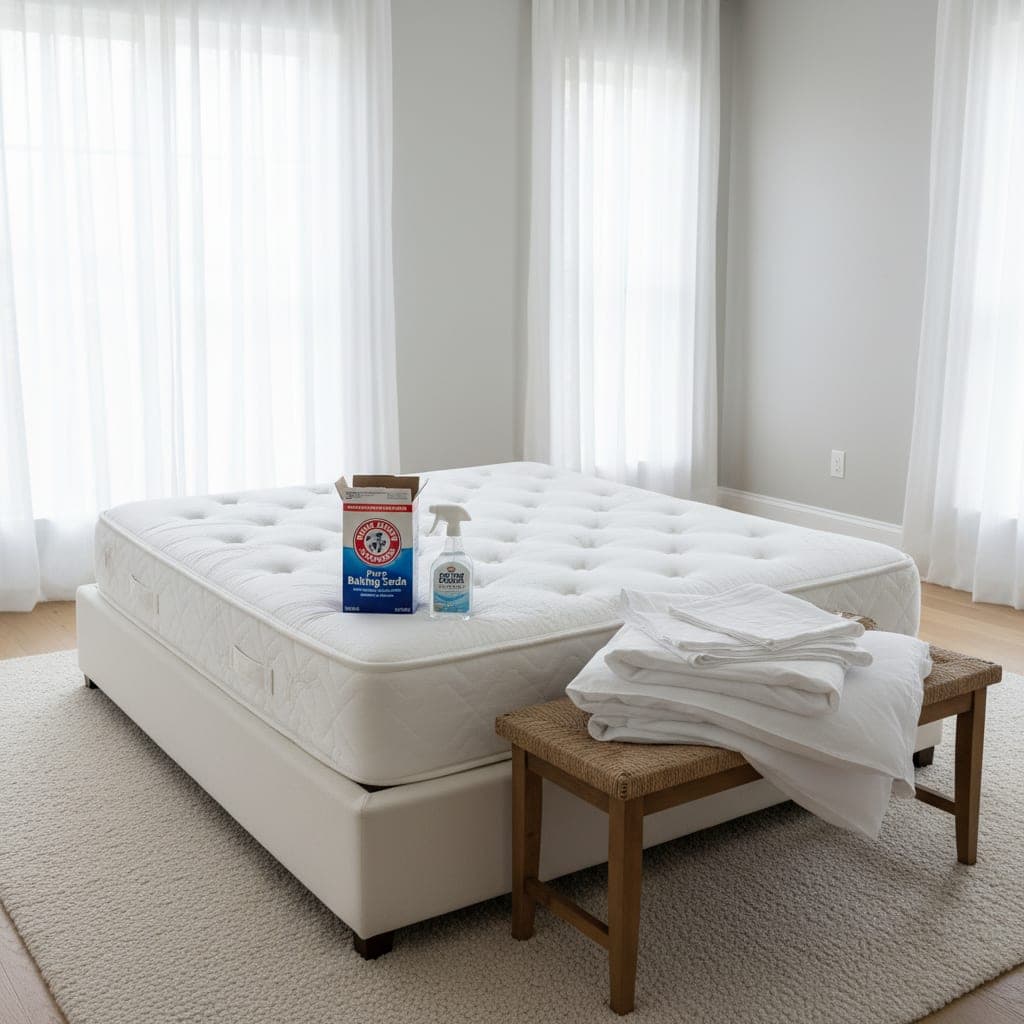
This is where the usual advice fails. Sprinkle, wait 20 minutes, vacuum, is not long enough to do anything except remove a little surface moisture. For baking soda to draw out the sweat, oils and humidity held in the fibers it needs hours, with four as a minimum and overnight genuinely better. The longer dwell is what pulls the volatile compounds out of the foam or the ticking, which is where a persistent smell actually lives rather than on the surface. Pour one to two full boxes in an even layer across the whole top, then work it gently into the tufts and along the seams with a clean dry brush or your hand, since the fibers are where it needs to reach. Ten drops of lavender oil shaken into the box beforehand is optional and adds a light scent as the powder sits. Keep the room still while it works and the door shut. The natural rhythm is to strip the bed in the morning, treat the stains, spread the baking soda, go out for the day, and finish in the evening.
Vacuum again, more thoroughly than feels necessary
Once the baking soda has had its full dwell, vacuum the entire surface again with the same slow overlapping technique. This pass is removing the powder plus everything it absorbed, so rushing it leaves the absorbed oils and moisture on the bed rather than in the canister. Go slowly enough to pull powder out of the weave rather than off the top of it, and expect this to take longer than the first vacuum did. A faint white haze remaining means you need another pass, and possibly a third along the seams where powder collects. Run a hand across the surface afterward: it should feel dry, smooth and slightly cool. Anywhere that feels even faintly damp from the earlier stain work needs more drying time before the bed goes back together. Empty the vacuum outside rather than over a bin indoors, since you have just collected a canister of exactly the fine dust you were trying to remove from the room.
Dry it completely, which takes longer than you think
This is the most skipped step and the reason a freshly cleaned mattress sometimes smells musty a fortnight later. Any moisture left inside from stain treatment creates the warm, humid conditions that mildew needs, and a mattress is the hardest thing in a house to dry once that has started. After the final vacuum, give it at least two to four hours with a window open and a fan blowing across the surface, and longer for foam or for a humid day. Standing the mattress on its side near an open window roughly doubles the airflow and is worth the effort if you can manage it alone. Only remake the bed when the surface is genuinely room temperature dry rather than dry to a quick touch, and check the areas you treated specifically rather than the middle. If you have any doubt, leave it another hour. Nothing is gained by remaking the bed early and a great deal can be lost.
Skip the steam cleaner, or use it with real caution
Steam looks like the obvious tool for a mattress and it is the one most likely to cause harm, for the same reason the rest of this article keeps returning to: moisture. A steam cleaner introduces water into something that cannot be wrung out or put in a dryer, and on memory foam or latex that water reaches a core that may take several days to release it. Heat also sets protein stains, so steaming a mattress with old blood or urine on it makes those permanent rather than removing them. If you use one at all, keep it to a quick pass on an innerspring mattress, hold it moving rather than resting it in one place, and follow with hours of fan drying. The upholstery attachment on a good vacuum plus the baking soda treatment achieves more on a mattress than steam does, with none of the risk. Professional mattress cleaning services that use low moisture extraction are a different proposition and are worth considering for a genuinely bad mattress that you want to keep.
Rotate it, air it, and stop tucking the bed in immediately
Maintenance between deep cleans does more for a mattress than the deep clean does. Rotate it head to foot every three to six months so the compression is spread rather than concentrated where you sleep, and flip it as well if it is a traditional double sided model, though most modern mattresses are single sided and must not be flipped. Pull the covers back for half an hour each morning instead of making the bed straight away, because a made bed traps the moisture your body released overnight against the surface, and that humidity is what both mildew and dust mites depend on. Air the room properly, particularly in winter when windows stay shut. If the mattress sits on a solid platform or on the floor, condensation collects underneath with nowhere to go, so lift it periodically and check, and consider slats or a base that allows airflow. These habits cost almost nothing and they are the reason two identical mattresses can be in completely different condition after five years.
Get a protector on it before anything else goes back
A protector is what stops you having to do most of this again. A zippered encasement that covers all six sides is the version that matters for allergies and for anything involving bed bugs, since it seals the mattress rather than covering the top. A fitted waterproof protector is enough for spill protection alone. The trade off worth knowing is breathability: cheap vinyl backed protectors block moisture in both directions and make the bed hot and clammy, while a membrane backed fabric protector blocks liquid and still allows vapor through, which is what you want on a mattress you are trying to keep dry. Wash it on the schedule the label gives, usually every month or two, and treat it as the thing that gets cleaned instead of the mattress. Installed after a deep clean, it means the next session is mostly just the baking soda treatment, because the stain work will not need repeating. Toppers are worth a separate thought, because people often add one to a mattress that is already struggling and then wonder why the smell persists. A topper is a comfort layer, not a repair, and it will not fix sagging or a failed support core. It does need the same care as the mattress underneath: most are foam, so they take even less liquid, and they are far easier to air outside on a dry day. If a topper is what actually sits under the sheet, it is also what absorbs most of the sweat and oils, which makes it the thing to strip and treat first.
Which stains come out, and which never will
Worth being honest about, because the difference decides whether a Saturday is well spent. Fresh spills of almost anything, fresh blood in cold water, sweat yellowing, and surface urine all respond well. Old set-in urine that soaked to the core is the difficult case, particularly on foam, where the enzyme cleaner cannot reliably reach as deep as the liquid went, and repeat treatment sometimes improves it without fully clearing it. Ink, dye transfer from colored bedding, and anything that has been heat set by a previous attempt with warm water are usually permanent. Mold or mildew growing inside a mattress is not a cleaning problem at all: surface spotting can be treated, but growth in the core cannot be reached or removed, and a mattress that smells musty from the inside is finished. The same applies to bed bugs, where an encasement and professional treatment are the route rather than any cleaning method described here.
When a mattress is past cleaning
There is a point where a deep clean is effort spent on something that needs replacing, and recognizing it saves both the Saturday and the disappointment. Visible sagging or a permanent body impression means the support structure has failed, and no cleaning restores that. Springs you can feel, or a mattress that creaks and shifts under weight, are the same signal. Waking up stiff or sore when you do not have that problem elsewhere is worth taking seriously, since it usually predates the visible sagging. Persistent odor that survives a full enzyme and baking soda treatment generally means the source is in the core rather than the surface. Most mattresses have a usable life of somewhere between seven and ten years depending on construction and use, and a cheaper one reaches that sooner. If yours is near that age and you are cleaning it because of a smell rather than a spill, the honest answer is that the cleaning will disappoint and the money is better spent elsewhere.
The mistakes that make a mattress worse
Using too much liquid, which is the mistake with the worst consequences. Enzyme cleaner applied as though you were mopping soaks into foam, takes days to leave, and creates exactly the mold risk the cleaning was meant to prevent. Spray at a medium distance, enough to saturate the fibers but never enough to pool. Using warm or hot water on blood, urine or sweat, which permanently sets protein stains and rules out removing them later. Rubbing rather than blotting, which drives the stain deeper and spreads it wider. Cutting the baking soda dwell to 20 minutes, which is the difference between a mattress that smells fresh next week and one that does not. Remaking the bed before the mattress is genuinely dry. Skipping the second vacuum, which leaves residue that clumps into a gritty film under the sheets. And putting clean bedding onto a mattress you have just cleaned before the bedding itself has been washed, which undoes the whole morning.
Pro Tips
- Do this on a warm, dry day with the windows open and a fan running. Drying is the step that decides whether the clean holds, and weather does more for it than anything you can buy.
- Cold water on anything protein based, meaning blood, urine and sweat. Warm water sets those stains permanently and removes the option of trying again later.
- Give the baking soda hours rather than minutes. Overnight is the difference between drawing compounds out of the fibers and dusting the surface.
- Fit a zippered encasement once the mattress is dry. It means the next deep clean is mostly the baking soda step, since the stain work will not need repeating.
Frequently Asked Questions
How often should you deep clean a mattress?
Twice a year suits most people, with a lighter vacuum and baking soda pass every few months if anyone in the house has allergies. A mattress with a good zippered protector needs the full treatment less often, because the protector takes the sweat and oils that would otherwise reach the surface. Deal with spills immediately rather than waiting for the next scheduled clean, since almost every stain that becomes permanent does so because it was left to set.
What is the best way to remove urine smell from a mattress?
An enzyme cleaner, and nothing else reliably works. The smell comes from uric acid crystals that reactivate with heat and humidity, which is why ordinary cleaners seem to work and then fail a week later. Apply enough to reach as deep as the urine went, cover with a damp cloth, leave it 15 to 30 minutes, then blot from the outside inward with white cloths. Follow with a thick layer of baking soda left overnight. Old stains often need two applications, and urine that soaked into foam months ago may never fully clear.
Can you clean a memory foam mattress the same way?
Same method, much less liquid. Foam holds water like a sponge and has no air space for it to evaporate from, so moisture reaching the core can take days to leave and brings mildew with it. Use a barely damp cloth rather than a spray that pools, treat smaller areas at a time, and allow considerably longer drying with a fan. Skip steam cleaning entirely on foam. Test peroxide on a hidden corner first, as some foam covers are treated and react differently to it.
Does baking soda actually kill dust mites?
No, and any guide saying otherwise is overselling it. Baking soda absorbs moisture and odor compounds, which is genuinely useful and is why it is in this method, but it is not an insecticide. What actually reduces mites is removing their food source by vacuuming, washing bedding hot weekly, keeping indoor humidity below roughly 50 percent, and using a zippered allergen encasement so that whatever remains inside the mattress cannot reach you. Humidity control does more than any product applied to the surface.
How do you get blood stains out of a mattress?
Cold water only, and act before it sets. Mix one part 3 percent hydrogen peroxide to two parts cold water, mist lightly, let it bubble about five minutes, then blot from the outer edge inward with a clean white cloth. For older stains, work a little dish soap in with a fingertip, wait three minutes, and blot with cold water. Never use warm water, a hairdryer or steam, since heat sets the protein permanently and removes any chance of getting it out later.
Is it worth deep cleaning an old mattress?
It depends on what is wrong with it. Cleaning solves stains, surface odor and accumulated dust. It does not solve sagging, a permanent body impression, springs you can feel, or a musty smell coming from inside the mattress, all of which mean the structure or the core has gone. Most mattresses last somewhere between seven and ten years. If yours is near that and the problem is a smell rather than a spill, cleaning will probably disappoint and the effort is better spent choosing a replacement.
How this guide was made
This Deep Clean guide was researched, written, edited, and published by Fredler Pierre-Louis. The 16 steps below are built around Vacuum with an upholstery attachment and a crevice tool, Baking soda, one to two full boxes and An enzyme cleaner, the kind sold for pet urine, and the quantities and dwell times come from published cleaning-chemistry and manufacturer guidance for those materials, not from a controlled trial we ran ourselves. Where a popular version of this hack does not work, or is risky on a particular surface, this 15 min guide says so.
- Checked against manufacturer and materials guidance for the surfaces named.
- Reviewed by a person for chemical safety and surface compatibility before publication.
- Written to explain why a method works, not just to list steps.
- Corrected whenever a reader reports an error or an edge case we missed.
Read our full editorial policy or learn more about the team behind TryCleaningHacks.
Related Cleaning Guides
Safety Notes
- Never oversaturate a mattress. Moisture trapped in foam or coils is slow to leave and is far harder to deal with than the stain you were treating.
- Hydrogen peroxide lightens some colored and dark mattress fabrics. Test a hidden corner and wait five minutes before treating anything visible.
- Wear gloves with enzyme cleaners and peroxide, and ventilate the room while you work.
- Never mix hydrogen peroxide with vinegar in a sealed container, and never combine any cleaner here with bleach or an ammonia based product.
- Do not use a hairdryer, heater or steam to speed drying on a stain. Heat sets protein stains permanently and adds moisture rather than removing it.
- Get help to stand a mattress on its side. They are heavier and more awkward than they look, and the usual injury from this job is a back strain rather than anything chemical.
You might also like
7 Deep Cleaning Tricks That Save Hours Every Week
Most of the time spent cleaning a bathroom is spent waiting or backtracking, not scrubbing. Spraying one surface, waiting for it, wiping it, then starting the next one means you pay every dwell time separately. Batching those dwell times so every cleaner works at once is the single change that cuts the job roughly in half. None of this involves a gadget or a miracle spray, just the order you work in and where you stop wasting motion.
How to Deep Clean a Shower (10 Proven Methods)
I deep cleaned the same shower twice in one week once with my old routine and once with these ten methods applied in the right sequence. The difference wasn't even close. Here's what changed and the daily habit that eliminated most of my scrubbing for good.
30 Cleaning Myths You Need to Stop Believing
I believed most of these myths for years, and two of them left permanent marks on surfaces in my own house. This is the honest version of what I got wrong, why the popular advice fails, and the two safety myths that actually send people to the emergency room. I have kept the failures in here on purpose, because the mistakes taught me more than the wins did, and a myth is only dangerous while you still trust it.