

How to Clean White Sneakers So They Look New Again
White sneakers pick up scuffs and gray grime fast, and the trick to getting them white again is matching your method to the material. Here is how I clean white canvas, leather, and mesh sneakers, plus soles, laces, and yellowing, without wrecking them.
Jump to a section
- What you'll need
- Step-by-step
- Start by figuring out what your sneakers are actually made of
- Knock off loose dirt and pull the laces first
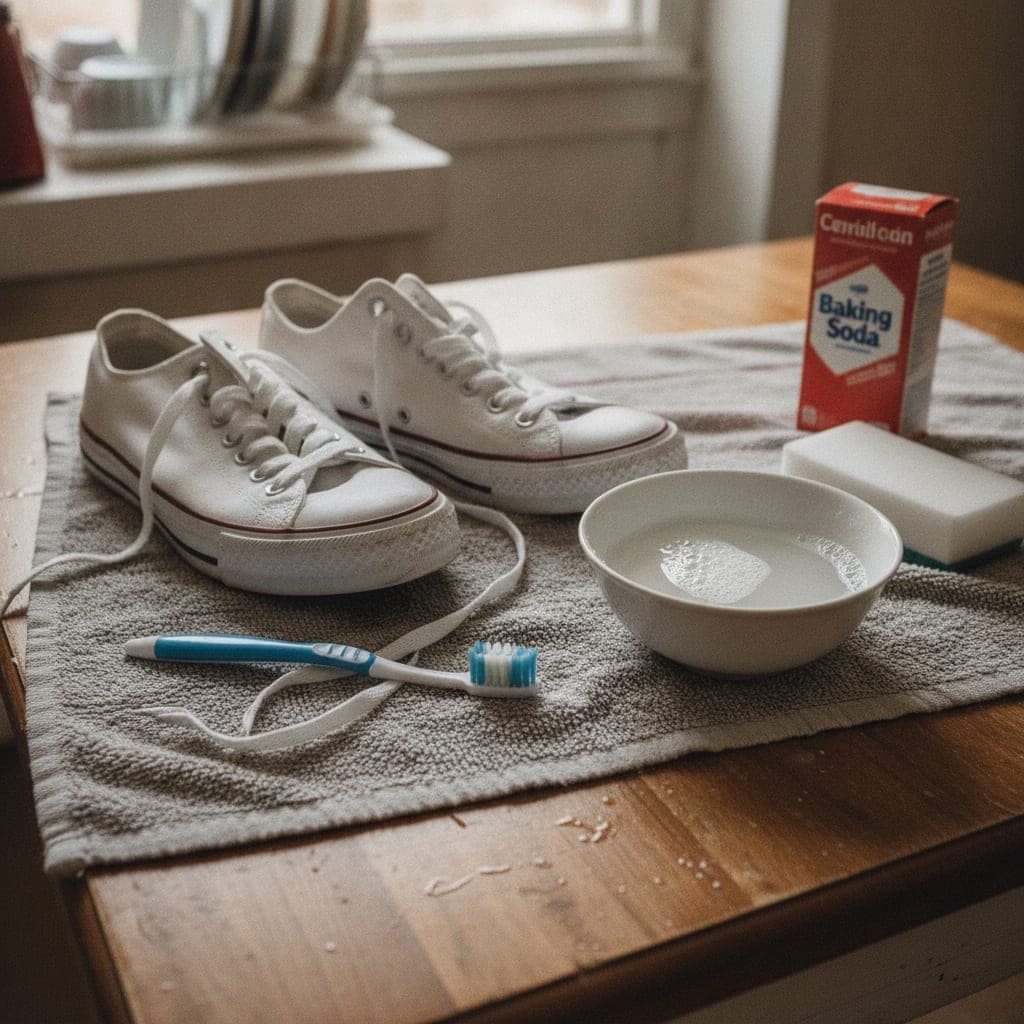
- White canvas: scrub with a baking soda and dish soap paste
- White leather: clean gently, never soak, then condition
- Mesh and knit runners: dab, don't drown, and go easy
- Soles and midsoles: magic eraser for the white rubber
- Pro tips
- FAQ
What You'll Need
Step-by-Step Instructions
Start by figuring out what your sneakers are actually made of
Before I touch water to any white shoe, I flip it over and look hard at the upper. This one step decides everything else, because canvas, leather, and mesh all react differently, and the method that saves one will ruin another. White canvas like Converse Chuck Taylors or Vans is woven cotton, so it can take a real scrub and even a soak. White leather (think Air Force 1s or Stan Smiths) is coated and does not want to be soaked, or the material stiffens and cracks. Mesh and knit running shoes, like a lot of Nikes and Adidas Primeknit, are delicate and grab dirt deep in the weave, so aggressive scrubbing frays them. Check the tongue tag for any care note, though most sneakers give you nothing useful there. Run your fingernail lightly across the toe: smooth and slightly rubbery means leather or synthetic leather, fabric texture means canvas or mesh. I keep three mental buckets and treat each pair accordingly. If your shoe mixes materials, and many do, with a leather toe cap and a mesh body, plan to clean each section with its own method rather than blasting the whole thing one way. The honest truth is that skipping this step is why people end up with stiff, water stained, or yellowed shoes. Two minutes of looking saves you an hour of regret. Once you know your material, gather your supplies for that bucket and lay down an old towel to work on.
Knock off loose dirt and pull the laces first
I never start wet. Take both shoes outside or over a trash can and clap the soles together to dislodge caked mud and grit, then use a dry medium stiff brush to sweep loose dirt off the upper and out of the tread. Getting the loose stuff off first means you are not just grinding it deeper into white fabric the second you add water. Now pull the laces all the way out. People skip this constantly and then wonder why the shoe still looks dingy near the eyelets. Laces trap gray grime, and you cannot reach under them while they are threaded. Set the laces aside to wash separately (I cover that later). With the laces out, open the tongue and brush into the creases and around the eyelet row, where dirt hides. For mesh, keep the brush soft and go gently, because a stiff brush will pill and fray the knit. For canvas and leather you can be firmer. A quick troubleshooting note: if you see a lot of embedded black scuff marks at this stage, mark them mentally, because those need a magic eraser or a targeted treatment rather than a general wash, and a plain brush will not touch them. Honestly, the dry pass is the least glamorous part and the one everyone rushes, but doing it well is the difference between cleaning your shoes and smearing the dirt around. If the tread is packed with pebbles or hardened mud, pop them out now with a toothpick or the tip of the brush handle, since grit left in the sole scratches the rubber the moment you start scrubbing wet.
White canvas: scrub with a baking soda and dish soap paste
Canvas is the forgiving one, so this is where you can actually get in there. In a small bowl I mix about two tablespoons of baking soda, one tablespoon of mild dish soap, and enough warm water to make a spreadable paste, roughly the texture of toothpaste. This is essentially a baking soda paste, and the mild grit is what lifts ground in dirt from woven cotton without harsh chemicals. Dip a toothbrush or soft scrub brush in the paste and work it into the canvas in small circles, section by section, paying extra attention to the toe and the dingy band near the sole. Let the paste sit on the fabric for 10 to 15 minutes so it can pull dirt up, then scrub again. For canvas Converse and Vans you can be fairly aggressive; the fabric can take it. Wipe the paste off with a damp cloth, rinsing the cloth often, until no white residue remains. Do not soak the whole shoe unless it is fully canvas with a rubber sole and no leather trim, and even then, air dry slowly. Troubleshooting: if a gray shadow lingers, it is usually residue you did not rinse fully, so go over it once more with a clean damp cloth. Where this method falls short is deep set oil stains and old scuffs, which the paste lightens but rarely erases completely. For those, move on to the magic eraser step. Be patient and let it dry fully before judging the result, because wet canvas always looks darker than it will end up.
White leather: clean gently, never soak, then condition
Leather is the opposite of canvas, and treating it like canvas is the fastest way to ruin a nice pair. Do not dunk leather shoes and do not attack them with baking soda grit, which can dull the finish. Instead, mix a few drops of mild dish soap into a cup of warm water, dip a microfiber cloth, wring it until it is barely damp, and wipe the leather in gentle circles. Work in sections and keep rinsing the cloth. For stubborn marks on true leather, a dedicated leather cleaner is worth it, applied per its label. The key is that leather hates standing water; too much moisture makes it stiffen, crack, and sometimes yellow as it dries. Wipe, do not saturate. Once the upper is clean and you have removed the soap film with a second barely damp cloth, let it dry away from heat, then, and this part matters, apply a small amount of leather conditioner with a clean cloth. Conditioning replaces the oils cleaning strips out and keeps the leather from cracking. Buff off the excess. Troubleshooting: if the leather feels tacky afterward, you used too much conditioner, so buff more. An honest observation, the popular hack of scrubbing white leather with a baking soda paste like you would canvas is a mistake I made early on; it can leave a chalky, micro scratched haze on the coating that is hard to undo. Pay special attention to the creases across the toe box, where dirt collects and where cracking starts, and flex the shoe gently as you wipe so the cleaner reaches into the folds. Save the paste for canvas and rubber, and keep leather to gentle soap, a soft cloth, and conditioner. Slow and gentle wins here every time.
Mesh and knit runners: dab, don't drown, and go easy
Mesh and knit are the trickiest whites because the weave grabs dirt and the fibers fray if you get rough. I never soak these either, mostly because water plus embedded dirt spreads into a wider stain and the shoe takes forever to dry, which invites odor. Start with a very soft brush or an old toothbrush and a solution of a little mild detergent in warm water. Dip the brush, tap off the excess so it is damp rather than dripping, and work the mesh in light, short strokes following the direction of the weave. For spot stains, a mesh safe or oxygen based (chlorine free) stain treatment dabbed on with a cotton swab and left 5 to 10 minutes lifts more than scrubbing does. Blot with a barely damp cloth to rinse, then blot dry with a clean towel; pressing a dry cloth into the mesh pulls moisture and loosened dirt out of the weave. Troubleshooting: if you see fuzzing or pilling starting, stop immediately and switch to dabbing only, because once knit frays there is no fixing it. Where the common advice fails, tossing mesh runners in the washing machine, which forums love to recommend, is a gamble; it can warp the midsole, break down glued seams, and leave detergent trapped in the foam that yellows later. If you insist on the machine, use a mesh laundry bag, cold water, gentle cycle, and never the dryer, but I would rather hand clean and keep the shoe intact. For sweat stains and salt lines that bloom on light mesh, a slightly damp cloth with a single drop of detergent, worked in and blotted straight out, lifts them better than soaking the whole panel. Take your time with mesh; patience beats force.
Soles and midsoles: magic eraser for the white rubber
The rubber soles and midsoles are usually the dirtiest part and, luckily, the easiest to make look new. My favorite tool here is a magic eraser (melamine sponge). Wet it, squeeze out most of the water so it is just damp, and rub the white rubber sole, midsole, and toe bumper. It works like fine sandpaper at a microscopic level, so it erases black scuffs and gray grime from rubber almost magically. Go over the whole white rubber perimeter, rinsing the eraser as it grays and re wetting as it wears down; a single sponge often does not survive a badly scuffed pair, so have a spare. For grime packed into the sidewall texture, a toothbrush with the baking soda and dish soap paste from the canvas step scrubs it out. Rinse with a damp cloth. Troubleshooting: keep the magic eraser off any painted logos, printed text, or glossy finishes, because that same micro abrasion will scrub the print right off, and I have faded a logo learning that. Also keep it mostly on rubber, not fabric or leather uppers, where it can dull the surface. An honest note, yellowed midsoles are a different problem than surface grime; if the rubber has gone yellow rather than just dirty, the eraser will not fix it, and that is oxidation, which I cover in the yellowing step next. For everyday black marks and scuffs, though, nothing I have tried beats a damp melamine sponge on white rubber. It is genuinely satisfying to watch the sole go bright again.
Fixing yellowed white shoes with a baking soda and vinegar paste
Yellowing is its own beast. It happens from oxidation, sun exposure, sweat, and, ironically, from bleach, and it is chemically related to the same yellowing that turns white pillows dingy over time. For yellowed canvas and rubber, I make a paste of two tablespoons baking soda, one tablespoon white vinegar, and a squeeze of dish soap; it fizzes, which is normal. Brush it onto the yellowed areas with a toothbrush, then, if you can, set the shoes in direct sunlight for one to two hours while the paste stays on. Sunlight plus the paste is the old school whitening method and it genuinely helps lift surface yellowing. Brush again, then rinse thoroughly with a damp cloth and dry fully. For yellowing on leather, skip the paste and use a leather cleaner instead, because the grit and acid can damage the coating. Troubleshooting: if one treatment only lightens the yellow, repeat it; deep oxidation often needs two or three rounds and will not vanish in one pass. The honest limit here is that severe, set in yellowing, especially on aged midsole rubber that has oxidized all the way through, may never come fully white again, and no home method reliably reverses that. Anyone promising a one wipe fix for yellowed foam is selling something. Manage your expectations: you can dramatically improve most yellowing, but decade old oxidation is often permanent. Do not reach for chlorine bleach to speed this up, which brings me to the most important warning.
Why chlorine bleach is the worst thing for white shoes
This is the mistake I see most, and it is worth its own step because it feels so counterintuitive. Chlorine bleach does not whiten white sneakers; it yellows them. Here is why: most white shoe materials, canvas, synthetic uppers, and especially rubber, contain optical brighteners and polymers that react with chlorine and turn a stubborn yellow or orange that is far worse than the dirt you started with. I learned this the hard way on a canvas pair I thought I was rescuing, and the yellow never fully came out. So the rule is simple: no chlorine bleach on white shoes, ever, not diluted, not as a soak, not dabbed on. If you want a bleaching type boost for canvas, use an oxygen based (chlorine free) product instead, which lifts stains without the yellowing reaction. And a hard safety line that applies to any cleaning, never mix bleach with vinegar, ammonia, or hydrogen peroxide; those combinations release toxic gases and are genuinely dangerous. Since I lean on baking soda and vinegar for whitening, this is exactly why I keep bleach out of the picture entirely. Troubleshooting: if you have already bleached a pair and it yellowed, try the baking soda and vinegar paste with sun from the yellowing step; it sometimes pulls the chlorine yellowing back partway, though not always. The honest takeaway is that the fastest looking shortcut, splashing bleach on white shoes, is the one that most reliably wrecks them. Skip it and stick to the gentler methods above, which actually work and will not gas you out of your laundry room.
Cleaning the laces and drying everything without yellowing
Back to those laces you pulled in step two. White laces get gray fast and cleaning them separately makes the whole shoe look newer. I put them in a bowl with warm water, a squeeze of dish soap, and a spoon of baking soda, let them soak 15 to 20 minutes, then rub them between my fingers or scrub lightly with a toothbrush. Rinse well. For dingy fabric laces you can also seal them in a mesh bag and run them through the washing machine, but air dry them; never the dryer. Now, drying, which is where good cleaning gets undone. Heat is the enemy: do not put white sneakers in the dryer, on a radiator, in direct blazing sun for hours, or in front of a heater, because heat both yellows the materials and can warp glued midsoles and pop seams. Instead, stuff each shoe with white paper towels or a clean white cloth (not newspaper, whose ink transfers) to hold the shape and wick moisture from the inside, then air dry in a well ventilated spot out of direct heat. The paper stuffing also stops the yellow water ring stains that form when moisture wicks unevenly through canvas as it dries. Change the stuffing once it is damp. Troubleshooting: if you get a faint yellow tide line as the shoe dries, it means it dried too slowly or unevenly with dirt still in the fabric; re clean that spot and dry faster with more airflow. Give leather and mesh a full day, and thoroughly wet canvas up to two, before you decide the job is done.
Protect them so the next clean is easy
The last step is the one that makes every future cleaning shorter, and I almost always skip it when I am in a hurry, then regret it. Once your sneakers are fully clean and completely dry, treat them to protect the surface. For canvas and mesh, a water and stain repellent spray (the kind made for fabric footwear) creates a barrier so dirt and liquids bead up instead of soaking in. Hold the can about six inches away, mist an even coat, let it dry, and add a second light coat. Do this outdoors or in a very well ventilated space, because the fumes are strong, and check that the product is rated for your material. For leather, the protection is the conditioner from the leather step plus an occasional leather protectant; conditioned leather resists staining and cracking far better than bare, dried out leather. A quick wipe down habit helps more than any spray: after wearing white shoes, give the rubber a fast pass with a damp cloth or magic eraser before scuffs set, and brush loose dirt off the upper the same day. Troubleshooting: if water stops beading after a few weeks of wear, the repellent has worn off and it is time to reapply, usually every month or two for shoes in regular rotation. Honestly, protection will not make white sneakers immortal, and they will still need real cleaning eventually. But a treated, regularly wiped pair stays white longer and cleans up in minutes instead of an hour, which is the whole point of not dreading the next round.
Pro Tips
- Clean shoes in daylight or under bright light so you can actually see the gray shadows and scuffs you are targeting; kitchen lighting hides a surprising amount of grime.
- Always test any cleaner or paste on a hidden spot first, like the inner heel or under the tongue, especially on leather and colored sole shoes, before committing to the whole surface.
- Keep a magic eraser and a damp cloth by the door and give the white rubber a ten second wipe after each wear; catching scuffs before they set means you almost never need a full deep clean.
- Work on one shoe at a time and finish it completely so you have a clean reference next to the dirty one; it is much easier to see whether you have actually lifted the dinginess.
- Buy a spare magic eraser before you start a badly scuffed pair; melamine sponges crumble as you use them and running out mid job is annoying.
- White canvas sneakers are forgiving, but leather is not, harsh cleaners dry it out and crack it. For leather shoes, bags, or jackets with spots, follow how to clean leather mold safely instead.
Frequently Asked Questions
Can I just throw my white sneakers in the washing machine?
For fully canvas shoes with rubber soles and no leather trim, a cold, gentle cycle inside a mesh laundry bag can work, and I have done it in a pinch. But for leather, and especially for mesh or knit runners, I avoid it. The machine can warp midsoles, break glued seams, and trap detergent in the foam that yellows over time. Never put any sneakers in the dryer. Hand cleaning by material is gentler and gives a better result on anything but plain canvas.
Does the baking soda and vinegar trick really whiten shoes?
Yes, for canvas and rubber it genuinely helps, especially combined with an hour or two of sunlight while the paste sits on the shoe. The mild abrasion lifts dirt and the sun assists the whitening. It is not magic, though. Deep oxidation on old yellowed midsoles often will not come fully white no matter how many rounds you do. It works best on surface dinginess and light yellowing, not decade old, set in discoloration.
Why did my white shoes turn yellow after I washed them?
Usually one of three things: you used chlorine bleach (which yellows white shoe materials rather than whitening them), you dried them with heat, or they dried too slowly and unevenly and left a yellow tide line as dirty water wicked through the fabric. The fix is to re clean the yellowed area, skip bleach entirely, stuff the shoes with white paper towels, and air dry with good airflow away from any heat source.
How do I get black scuff marks off white rubber soles?
A damp magic eraser (melamine sponge) is the best tool I have found. Wet it, wring out most of the water, and rub the scuff on the white rubber and it lifts off with almost no effort. For grime packed into textured sidewalls, use a toothbrush with a baking soda and dish soap paste. Just keep the eraser off any printed logos or glossy finishes, because it will scrub the print right off along with the scuff.
How long do white sneakers take to dry, and can I speed it up?
Leather and mesh usually need about a full day, and thoroughly wet canvas can take up to two. You can speed drying safely with airflow, such as a fan in a well ventilated room, and by stuffing the shoes with white paper towels or cloth to wick moisture from inside; change the stuffing when it gets damp. Do not use heat to rush it. A dryer, radiator, or heater will yellow the material and can warp the shoe, undoing all your cleaning work.
How often should I clean and protect my white sneakers?
A quick wipe of the rubber and a brush off of the upper after each wear prevents most buildup and means you rarely need a full deep clean. Do a proper wash whenever they look dingy, and reapply repellent spray or leather conditioner every month or two for shoes you wear regularly, or whenever water stops beading off the surface. Staying on top of it with small habits is far less work than reviving a badly neglected pair.
How this guide was made
This Deep Clean guide was researched, written, edited, and published by Fredler Pierre-Louis. The 10 steps below are built around Soft toothbrush and a medium stiff scrub brush, Microfiber cloths and a couple of clean rags and Mild dish soap or gentle laundry detergent, and the quantities and dwell times come from published cleaning-chemistry and manufacturer guidance for those materials, not from a controlled trial we ran ourselves. Where a popular version of this hack does not work, or is risky on a particular surface, this 16 min guide says so.
- Checked against manufacturer and materials guidance for the surfaces named.
- Reviewed by a person for chemical safety and surface compatibility before publication.
- Written to explain why a method works, not just to list steps.
- Corrected whenever a reader reports an error or an edge case we missed.
Read our full editorial policy or learn more about the team behind TryCleaningHacks.
Related Cleaning Guides
Safety Notes
- Never use chlorine bleach on white sneakers. It reacts with the brighteners and rubber and turns them a permanent yellow or orange that is far worse than the original dirt.
- Never mix bleach with vinegar, ammonia, or hydrogen peroxide. Those combinations release toxic gases. Since these methods use vinegar, simply keep bleach out of the process entirely.
- Use protectant and repellent sprays only outdoors or in a very well ventilated area, away from open flames, because the aerosol fumes are strong and flammable.
- Keep white shoes away from dryers, radiators, heaters, and prolonged direct sun while drying. Heat yellows the materials and can warp midsoles and loosen glued seams.
You might also like
7 Deep Cleaning Tricks That Save Hours Every Week
Most of the time spent cleaning a bathroom is spent waiting or backtracking, not scrubbing. Spraying one surface, waiting for it, wiping it, then starting the next one means you pay every dwell time separately. Batching those dwell times so every cleaner works at once is the single change that cuts the job roughly in half. None of this involves a gadget or a miracle spray, just the order you work in and where you stop wasting motion.
How to Deep Clean a Shower (10 Proven Methods)
I deep cleaned the same shower twice in one week once with my old routine and once with these ten methods applied in the right sequence. The difference wasn't even close. Here's what changed and the daily habit that eliminated most of my scrubbing for good.
30 Cleaning Myths You Need to Stop Believing
I believed most of these myths for years, and two of them left permanent marks on surfaces in my own house. This is the honest version of what I got wrong, why the popular advice fails, and the two safety myths that actually send people to the emergency room. I have kept the failures in here on purpose, because the mistakes taught me more than the wins did, and a myth is only dangerous while you still trust it.