

How to Clean Baseboards Without Bending Over for Hours
Baseboards are the thing you notice in someone else's house and stop seeing in your own. Then a low sun comes through the window at four in the afternoon and there is a gray line running the length of the room. The job itself is not hard, but it is easy to do in a way that costs an hour, wrecks your knees, and leaves the trim looking patchier than before you started. Here is what actually gets them clean, which finish you have and why that changes the method, and the two popular tricks that quietly damage paint.
Jump to a section
- What you'll need
- Step-by-step
- Why baseboards collect more than the wall above them
- Work out which finish you have before you pick a cleaner
- Vacuum the floor first, then the trim, and never the other way round
- The sock trick for a dry pass without bending
- Mix the mildest solution that will do the job
- Clean standing up with a mop head and a cloth
- Pro tips
- FAQ
What You'll Need
Step-by-Step Instructions
Why baseboards collect more than the wall above them
Baseboards are the only part of a wall with a horizontal ledge, and that ledge sits at the exact height where dust settles out of the air. Air currents through a room carry fine particles along the floor, they slow at the wall, and whatever they are carrying drops onto the top edge of the trim. Add static in dry air, which holds fine dust against painted surfaces, and the result is a line of gray that builds evenly along the whole length rather than in patches. Two consequences follow from that. The dirt on top of the trim is loose dust and comes off dry, while the dirt on the face is usually scuffing, splashes, and mop marks that need liquid. They are two different jobs on one piece of wood, and treating the whole thing as one wet wipe is why baseboards often look worse afterward.
Work out which finish you have before you pick a cleaner
This is the step that decides everything else, and almost no guide leads with it. Painted trim in matte or flat finish is the most delicate: it holds dirt, and rubbing it burnishes the surface into a shiny patch that will not go away. Satin and semi-gloss paint, which is what most modern baseboards use, is much more robust and takes a damp cloth happily. Stained and varnished wood does not want water sitting on it and does not want anything alkaline. Vinyl or PVC trim tolerates almost anything. The one to identify carefully is MDF, which is what a great many painted baseboards actually are underneath, and MDF swells irreversibly if water reaches the core through a chip or an unpainted cut end. The tell is the cut end at a doorway: a fine, uniform, cardboard-like edge means MDF, visible wood grain means timber. If it is MDF, everything below still applies, but your cloth needs to be barely damp rather than wet, and any chipped spot should stay dry.
Vacuum the floor first, then the trim, and never the other way round
Cleaning the baseboards before vacuuming the floor guarantees doing them twice, because running a vacuum along the floor throws a fine cloud that settles straight back onto the trim you just wiped. Floor first, trim second, in that order, every time. Then vacuum the baseboards themselves with a soft brush attachment, running along the top edge and into the gap where the trim meets the floor. Use the brush, not the bare crevice tool, because a hard plastic nozzle dragged along painted trim leaves gray scuff lines that are then their own job to remove. If the vacuum has a suction control, turn it down a little so the brush glides rather than gripping. This dry pass is doing most of the work in the whole article. Skipping it is what turns settled dust into a wet gray smear that you then push into every corner.
The sock trick for a dry pass without bending
For maintenance dusting between real cleans, pull an old sock over your hand and run it along the top of the baseboard as you walk the room. It works because the cotton picks up dust rather than pushing it, and because your hand follows the curve of the molding better than any tool. It also costs nothing and turns a task you would put off into something done while walking through. For the bending problem, the same idea scales up: put the sock over the head of a flat mop, or over a broom, and reach the whole run standing upright. If your baseboards have deep profiles with grooves, a sock beats a flat cloth because you can push a finger into the groove and follow it. Shake the sock out into a bin rather than the sink, then wash it with rags rather than clothes.
Mix the mildest solution that will do the job
For satin or semi-gloss painted trim, a few drops of dish soap in warm water is genuinely enough for the whole job. Aim for barely soapy rather than sudsy, because suds mean a rinse pass, and a rinse pass doubles the work. Wring the cloth until it feels damp rather than wet: it should not leave a visible line of moisture on the paint. On stained or varnished wood, skip the soap and use a barely damp cloth, then dry immediately, because water sitting in the grain lifts finish over time. Keep vinegar away from waxed or oiled wood and off any natural stone plinth, since the acid dulls both. For grease near a kitchen, warm water and dish soap still works, it just needs a second pass and a little patience rather than a stronger product. Change the water when it goes gray. Wiping with dirty water is the difference between clean trim and trim with a faint even film on it.
Clean standing up with a mop head and a cloth
The back-saving version of this job is a flat head mop with a microfiber pad, worked along the baseboard horizontally. It covers a long run quickly and keeps you upright, which matters more than it sounds if you have a whole floor of a house to do. Two adjustments make it work properly. First, wring the pad much drier than you would for a floor, since a wet pad drips down the trim and pools along the floor edge. Second, tilt the head so one edge leads, which lets it get into the top corner rather than skating across the face. The mop will not do the corners or the profile grooves, so accept that and plan a second pass with a cloth for those. A sensible division is mop for the long flat runs, cloth by hand for corners, doorframes, and anywhere the trim meets another surface.
Scuffs, marks, and the reason a melamine sponge is not free
Melamine foam, sold as a magic eraser, removes scuffs impressively, and it does so because it is a very fine abrasive rather than a chemical cleaner. That is the part the internet leaves out. On satin and semi-gloss paint it will lift the mark and take a little of the sheen with it, leaving a slightly duller patch that you notice when light hits it at an angle. On flat paint the effect is worse, because there is less finish to spare. So use it in the smallest area that solves the problem, keep it away from the surrounding paint, and stop as soon as the mark goes rather than working the whole length of trim with it. Test on a hidden run first, behind a door or under a sofa, and look at the test spot in raking light rather than straight on. For lighter marks, try a damp cloth with a spot of dish soap and firm pressure first. It handles more scuffs than people expect and it costs no sheen.
Corners, grooves, and the gap along the floor
The inside corners are where dust compacts into a solid line, and no cloth reaches them properly. An old toothbrush dipped in the same soapy water breaks it up in a couple of seconds per corner, and a cotton swab clears what is left in a tight profile. Work the brush along the groove rather than scrubbing across it. The other neglected spot is the gap between the bottom of the baseboard and the floor, which collects crumbs, hair, and grit, and which is genuinely worth clearing because that grit gets walked into the floor finish and abrades it. The vacuum brush gets most of it. If the gap is wide and open, a length of caulk sealed along it stops the problem recurring, which is a small job with a large payoff in a kitchen. Do the doorframes and the door bottoms while you are down there, since they carry the same gray line and nobody thinks of them until they are pointed out.
Dry as you go, and why that is not optional
Wet paint attracts dust while it is drying, so a run left to air dry will collect a fresh layer within the hour and look no better than when you started. Follow the damp cloth with a dry one, or with a dry microfiber on the mop, within a minute or two rather than at the end of the room. Drying also prevents the water marks and faint tide lines that show up on satin paint once it dries, which are the marks people mistake for dirt they failed to remove. Take a moment at the floor edge as well: water that has run down and pooled against the floor will mark wood and can creep under vinyl. A dry towel laid along the base of the wall while you work catches drips before they become a second job.
The dryer sheet trick, honestly assessed
Rubbing a used dryer sheet along clean baseboards is the most repeated baseboard tip on the internet. It does something real: dryer sheets carry a fabric softening coating that reduces static, and less static means fine dust settles rather than clinging. On a painted baseboard in a dry house, it is a noticeable difference for a few weeks. There are two honest caveats. The coating is a residue, and repeated applications build up a faint film that eventually attracts more than it repels, so this is a trick to use occasionally rather than every clean. And on stained or varnished wood it can leave a dull patchiness, so keep it to painted trim. Use a sheet that has already been through a dryer cycle rather than a fresh one, since a fresh sheet deposits far more coating than you want on a wall.
Furniture polish and dust repellents are usually a step too far
The suggestion to lay a thin coat of furniture polish on painted baseboards comes up regularly, and it is worth being cautious. Silicone based polishes leave a slick surface that shows fingerprints and handprints along a wall, they can complicate any future repainting because paint does not adhere well over silicone, and on trim near a doorway the slipperiness is not helpful. If the goal is less frequent dusting, the anti-static effect of a dryer sheet gets you most of the way with less commitment. If the goal is protecting the paint, a coat of the correct paint is the real answer, not a polish. The one place a polish makes sense is on stained and sealed wood trim, where a wood specific product is doing the job it was designed for.
Pet hair behaves differently and needs a different tool
In a house with animals, baseboards collect hair rather than dust, and hair does not respond to the same approach. It clings by static along the bottom edge and in the gap at the floor, and a damp cloth pushes it into a rope rather than picking it up. A rubber squeegee drawn along the bottom edge gathers it into a line you can lift, and a dry rubber glove does the same thing on profiles. Vacuum before anything else, as always, and expect to do the bottom two inches of the trim more often than the top. It is also worth knowing that the anti-static logic cuts both ways here: reducing static genuinely helps with hair, so the dryer sheet trick earns its place more in a pet household than anywhere else.
Know when cleaning has stopped being the answer
Some marks are not dirt. Yellowing on white trim in a sunny room is the paint itself changing and no cleaner will reverse it. A shiny patch is burnished paint where someone has scrubbed, and more scrubbing deepens it. Chips and dents in MDF that have gone soft have taken on water and need filling rather than washing. Recognising these saves real time, because the instinct is to keep working at a mark that was never going to move, and the harder you work the worse the surrounding finish gets. Once a run of trim needs more than spot attention, a coat of paint on the baseboards is a modest job that resets everything, and it is the right call rather than an admission of defeat. If you do repaint, choose satin or semi-gloss rather than flat, because you will be cleaning it for years afterward and the sheen is what makes that easy.
A sensible order through the house, and how long it really takes
Work one room at a time and complete it before moving on, rather than doing all the vacuuming in the house and then all the wiping, because a half done room is where this job gets abandoned. Within a room, start at the door and work in one direction around the perimeter so you always know where you stopped. Do the vacuum pass for the whole room first, then the damp pass, then dry. An average bedroom takes roughly ten to fifteen minutes end to end if the trim is only dusty, and considerably longer the first time you do it properly on trim that has never been cleaned. Kitchens and hallways take the longest, since kitchens add grease and hallways add scuffing. Give the first session more time than you think it needs and expect subsequent ones to be quick.
Maintenance that keeps this from becoming an annual event
Once the trim is properly clean, the sock or a dry microfiber along the top edge once a fortnight is genuinely enough, and it takes a couple of minutes a room. Tie it to something you already do, like the week you change the bedding, because a task with no trigger gets skipped. Beyond that, the two things that reduce baseboard dirt at the source are a decent mat at the entrance and a shoes off habit, since most of the dark grit that ends up on trim in a hallway walked in on someone's feet. If you mop floors, keep the mop off the baseboards: repeated wet contact along the bottom edge is what causes the paint there to fail first, and dirty mop water leaves a tide line that becomes its own job.
Baseboard heaters and vents are a different job
If your baseboards are actually heaters, the metal fin type with a hinged cover, treat them as a separate task. Turn the power off at the thermostat or the breaker first, then lift or unclip the front cover, which usually comes away without tools. Inside is a row of thin aluminum fins that trap a surprising volume of dust and pet hair, and that trapped dust is why a heater smells scorched when the heating first comes on in autumn. Vacuum with the brush attachment along the fins, following their direction rather than across them, because the fins bend easily and a bent fin permanently reduces the heat it can move. A dry paintbrush loosens whatever the vacuum cannot reach. Keep liquid out of the housing entirely and wipe only the outer cover damp, ideally off the unit if it lifts away. The same caution applies to floor vents set into ordinary trim: vacuum them, wipe the visible louvres, keep water out.
Quarter round and the seam you keep missing
Many baseboards have a second, smaller strip along the bottom, quarter round or shoe molding, added to cover the gap where trim meets floor. It matters here for one reason. The seam between the two pieces is a horizontal ledge in miniature, and it collects a compacted line of grit that a cloth passes straight over. A toothbrush along that seam takes seconds and removes what is often the darkest line on the whole assembly. That lower strip is also the part that takes mop water, kicks, and vacuum knocks, so it wears first and shows scuffing worst, which is worth knowing before you attack it with a melamine sponge. If your quarter round is stained wood below painted trim, remember the two want different treatment: barely damp and dried at once on the wood, ordinary soapy cloth on the paint above.
Paint speckle and construction residue need a scraper, not a cloth
If the room has ever been painted or plastered, some of what looks like dirt is dried spatter, and scrubbing at it wastes effort while dulling the paint around it. Dried latex spatter lifts with a plastic scraper or an old bank card held at a shallow angle, worked along the trim rather than dug into it, and a minute under a warm soapy cloth first makes it release more easily. Do not reach for a metal blade, which gouges paint and scores wood. Plaster dust is the opposite problem: fine, alkaline, and it turns to slurry the moment it meets water, so it has to come off dry with a vacuum and a brush before any liquid appears. This is also the best argument for cleaning trim while you already have painting supplies out. Mid-project the trim is exposed, the drop cloths are already down, and any spatter you find is fresh enough to lift with a fingernail.
Mistakes that make baseboards look worse than when you started
Wet before dry, which turns settled dust into a smear and pushes it into every corner. Too much water, which marks satin paint, lifts finish on stained wood, and swells MDF at any chipped edge. Working the melamine sponge over a whole length rather than a single mark, which leaves a dull stripe. A hard vacuum nozzle instead of the brush, which adds gray scuffs while removing dust. Wiping with water that has gone gray, which lays down an even film that looks like nothing until the light changes. Air drying instead of drying by hand, which lets fresh dust land on a damp surface. And cleaning baseboards before vacuuming the floor, which is the one that costs you the entire job twice.
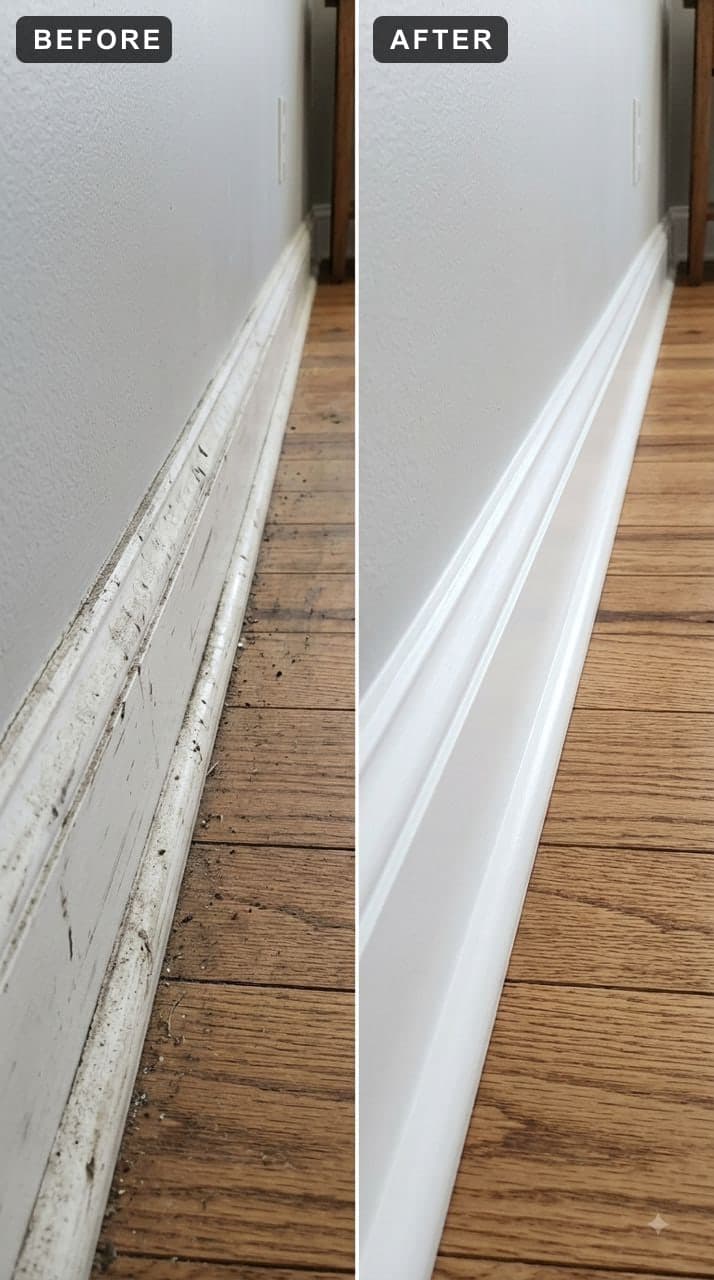
What the difference looks like
Pro Tips
- ✓Vacuum the floor before the trim, without exception. A vacuum throws a fine cloud that settles straight back onto anything you have just wiped, so the reverse order means doing the job twice.
- ✓Find a cut end at a doorway to identify MDF. A fine uniform edge with no grain means water needs to stay off any chipped spot, and your cloth wants to be barely damp.
- ✓Test a melamine sponge behind a door first and look at the test patch in raking light. It is a fine abrasive, so it lifts the scuff and some of the sheen with it.
- ✓Keep the mop off the baseboards when you do floors. Repeated wet contact along the bottom edge is where painted trim fails first.
Frequently Asked Questions
What is the fastest way to clean baseboards?
Vacuum the floor, then vacuum the trim with a soft brush attachment, then run a barely damp microfiber pad on a flat head mop along the length while standing upright, and follow with a dry pad. Corners and profile grooves get a toothbrush and a cotton swab afterward. An average bedroom is roughly ten to fifteen minutes if the trim is only dusty. The single biggest time saver is doing the dry pass first, because settled dust removed dry never becomes a smear you have to chase into corners.
Can I use a magic eraser on baseboards?
Yes for individual scuffs, with a caveat worth knowing. Melamine foam is a very fine abrasive rather than a chemical cleaner, so it lifts the mark and takes a little of the paint's sheen with it, leaving a slightly duller patch you notice in angled light. Use it on the mark only, not along the whole run, stop as soon as the scuff goes, and test behind a door first. For lighter marks a damp cloth with a spot of dish soap and firm pressure often works and costs no sheen at all.
Does the dryer sheet trick actually work on baseboards?
It does something real. Dryer sheets carry a fabric softening coating that reduces static, and less static means fine dust settles instead of clinging, which is noticeable for a few weeks on painted trim in a dry house. Two caveats: the coating is a residue that builds up with repeated use, so treat it as occasional rather than routine, and keep it off stained or varnished wood where it can leave dull patches. Use a sheet that has already been through a dryer cycle, since a fresh one deposits far more coating than you want on a wall.
How do I clean baseboards without bending over?
Put a microfiber pad or an old sock on a flat head mop or a broom and work the length standing upright. Wring the pad much drier than you would for a floor so it does not drip down the trim, and tilt the head so one edge leads and reaches the top corner rather than skating across the face. Accept that this will not do the corners or the deeper profile grooves, and plan a short second pass with a cloth by hand for those, ideally kneeling on a folded towel rather than squatting.
How often should baseboards be cleaned?
A dry pass along the top edge every couple of weeks keeps them from ever needing a real clean, and it takes a couple of minutes a room. The full damp clean is realistically a twice a year job in a bedroom, more often in a kitchen where grease settles and in a hallway where shoes scuff the face. Tie the quick dusting to something you already do on a schedule, such as the week you change bedding, because a task with no trigger attached to it is the one that gets skipped.
How this guide was made
This deep clean guide was researched, written, edited, and published by Fredler Pierre-Louis. The 19 steps below are built around Vacuum with a soft brush attachment, Two microfiber cloths and An old sock that fits over your hand, and the quantities and dwell times come from published cleaning-chemistry and manufacturer guidance for those materials, not from a controlled trial we ran ourselves. Where a popular version of this hack does not work, or is risky on a particular surface, this 14 min guide says so.
- Checked against manufacturer and materials guidance for the surfaces named.
- Reviewed by a person for chemical safety and surface compatibility before publication.
- Written to explain why a method works, not just to list steps.
- Corrected whenever a reader reports an error or an edge case we missed.
Read our full editorial policy or learn more about the team behind TryCleaningHacks.
Related Cleaning Guides
Safety Notes
- ⚠Do not mix cleaning products. Warm water with a little dish soap handles this entire job, and combining bleach with vinegar or ammonia produces genuinely dangerous fumes.
- ⚠Keep liquid away from electrical outlets, floor sockets, and heating vents set into the baseboard. Wipe around them with a barely damp cloth and dry immediately.
- ⚠Kneel on a folded towel or a cushion rather than working from a deep squat, and stand up periodically. This is a job people finish with a sore back because they held one position for an hour.
- ⚠Ventilate the room if you use anything stronger than soap and water, and never use a solvent based cleaner on painted trim in an unventilated hallway.
You might also like
7 Deep Cleaning Tricks That Save Hours Every Week
Most of the time spent cleaning a bathroom is spent waiting or backtracking, not scrubbing. Spraying one surface, waiting for it, wiping it, then starting the next one means you pay every dwell time separately. Batching those dwell times so every cleaner works at once is the single change that cuts the job roughly in half. None of this involves a gadget or a miracle spray, just the order you work in and where you stop wasting motion.
How to Deep Clean a Shower (10 Proven Methods)
I deep cleaned the same shower twice in one week once with my old routine and once with these ten methods applied in the right sequence. The difference wasn't even close. Here's what changed and the daily habit that eliminated most of my scrubbing for good.
30 Cleaning Myths You Need to Stop Believing
I believed most of these myths for years, and two of them left permanent marks on surfaces in my own house. This is the honest version of what I got wrong, why the popular advice fails, and the two safety myths that actually send people to the emergency room. I have kept the failures in here on purpose, because the mistakes taught me more than the wins did, and a myth is only dangerous while you still trust it.