

8 Things You Can Clean With WD-40 (That You Didn't Know)
Most people file WD-40 under squeaky hinges and forget it exists. It is better understood as a solvent that happens to come in an aerosol can, which is why it clears a soap scum film that bathroom sprays slide straight off. It is also the wrong answer for a long list of jobs people reach for it on, it leaves an oily film that has to be washed off, and on a shower floor that film is slippery enough to matter. Here are eight cleaning jobs it genuinely handles, with dwell times and technique for each, the surfaces where it does permanent damage, and why it works when a dedicated cleaner does not.
Jump to a section
What You'll Need
Step-by-Step Instructions
What WD-40 actually is, because it explains every use below
The name is short for Water Displacement, 40th formula, and that is the honest description of the product. It is a blend of petroleum solvents with a small amount of light oil, packaged as an aerosol. It is not grease, and it is not a long term lubricant, which is why mechanics get irritated when people treat it as one. Understanding that changes what you point it at. As a solvent, it dissolves things that are oily, waxy or greasy, and it creeps into tight gaps and under corrosion because it is thin. That is why it clears soap scum, adhesive residue, crayon wax and scuff rubber, and why it frees a seized screw. It also explains what it cannot do. It is not an acid, so it does not dissolve limescale the way vinegar or citric acid does, and where it appears to remove lime it is really lifting the greasy soap film binding those minerals to the surface so they wipe away. And it leaves a thin oil film behind, every single time, which is the part most articles never mention and the part that decides whether a job ends well.
Clear soap scum off a glass shower door
This is the job that converts skeptics, and the reason is chemistry rather than marketing. Soap scum is not dirt. It is largely the fatty acids from soap reacting with calcium and magnesium in hard water, which produces a waxy, greasy layer bonded to the glass. Most bathroom sprays are water based and detergent forward, so they sit on top of a waxy film and slide off it, which is why a door can defeat several different products in a row. A solvent goes at the wax directly. Mist a thin coat across the glass, wait about two minutes, then wipe top to bottom in straight vertical strokes with a dry microfiber cloth. Thin is the operative word: a heavy coat takes far longer to remove than it does to apply. Then, and this part is not optional, wash the glass with warm water and dish soap and dry it. Skipping the wash leaves an oily film that grabs dust, streaks in daylight, and runs down onto the shower floor. Doing this once a month stops the film re establishing rather than fighting it once a year. A few things change the result. Work on dry glass rather than a door still wet from a shower, because water sitting on the surface keeps the solvent from reaching the wax underneath. Use a fresh cloth for the second pass, since the first one is now loaded with dissolved scum and will simply redistribute it. If the glass still looks hazy after washing, the haze that remains is almost certainly etching or mineral deposit rather than soap film, and that needs an acid or, if the glass is genuinely etched from years of hard water, it does not come back at all. Knowing which of those two you are looking at saves a lot of pointless scrubbing, and the test is simple: soap film feels slightly slick or waxy under a dry fingertip, while etching feels like rough, dry glass.
Strip lime and calcium off faucets and fixtures
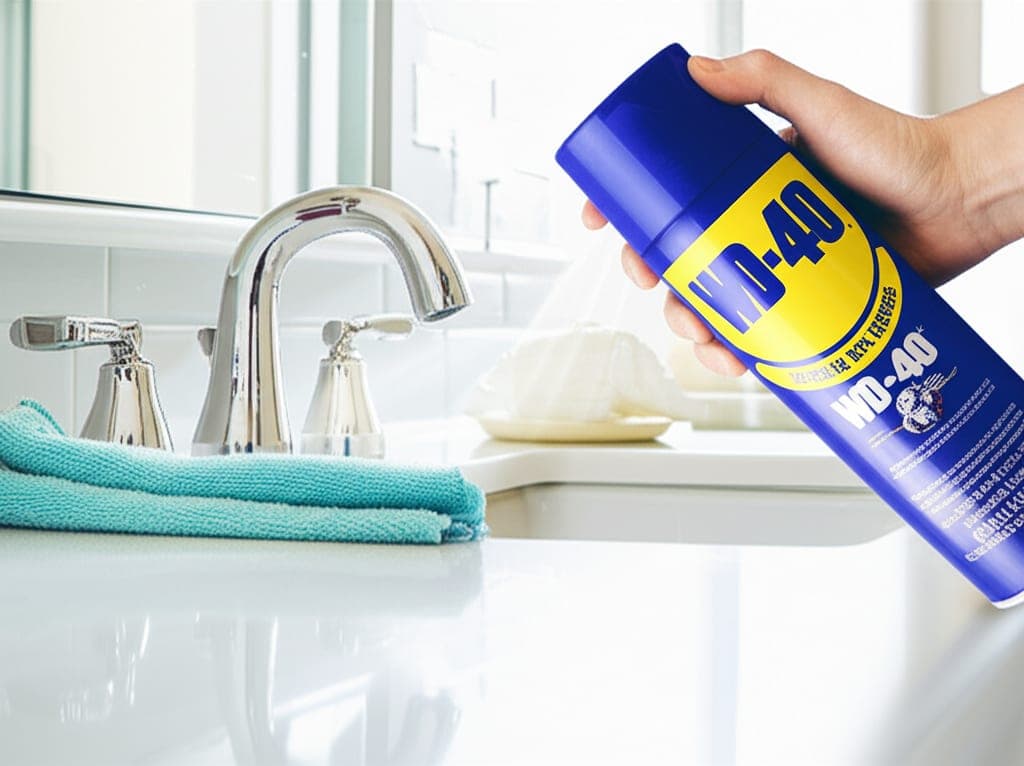
Spray it straight onto the fixture, give it about three minutes, then rub with a soft cloth. For the crevice where the handle meets the base, switch to an old toothbrush and work the solvent into the seam, which is where deposits build first and get missed longest. Technique matters more here than on glass. On brushed nickel, brushed stainless and matte black, always buff along the direction of the factory grain visible in the metal, never in circles. Circular buffing crosses that grain, and on a matte or brushed finish it leaves thousands of fine scratches that are invisible individually and read as a dull patch after a few months. Once dulled, that finish does not come back. Be clear about what is happening on heavy limescale: the solvent lifts the greasy film holding the deposit, but a thick crust needs an acid such as white vinegar or citric acid to actually dissolve the mineral. Finish every fixture with a soap and water wash, because an oily faucet handle is unpleasant to touch and collects grime faster than a clean one.
Dissolve sticker gunk, price labels and old tape
Adhesive residue is a solvent problem, which makes this one of the most reliable uses on the list. Spray a little directly onto the sticky patch, count to sixty, and the residue either rolls off under a cloth or peels away in one piece rather than shredding into a dozen tacky flecks. For a label still partly attached, soak the paper itself and give it a moment longer so the solvent can travel through and reach the glue underneath. Two cautions. Test on plastics first, because some clear plastics, particularly polycarbonate and clear polystyrene, can craze or cloud when a petroleum solvent sits on them, and that damage does not buff out. On painted or lacquered surfaces, work quickly and wipe rather than letting it pool. Glass, glazed ceramic, sealed metal and most hard plastics are straightforward. Wash the area afterward so the next thing you stick there actually sticks.
Wipe crayon off painted walls
Crayon is pigmented wax, so a solvent has an easy time with it while soap and water mostly smear it around. Spray a little onto a cloth rather than onto the wall, then wipe with gentle straight strokes following the direction of the crayon lines. Working along the marks rather than across them keeps you from spreading pigment into clean paint. On satin and semi gloss paint, which have a harder, less porous surface, this usually lifts marks cleanly on the first pass. Flat, matte and eggshell paints are genuinely riskier, because their porous surface absorbs the solvent along with the wax and can leave a patch that looks slightly darker or shinier than the wall around it. Test somewhere hidden first, behind a door or below a light switch. If the test patch changes sheen at all, stop and use a melamine sponge very lightly instead, accepting that it may burnish the paint. Some walls end up needing touch up paint, and knowing that before you start beats discovering it in the middle of a hallway.
Freshen dingy tile grout
Grout is porous cement, so it absorbs the soap, body oil and cooking grease that make it look gray, and a surface spray never reaches the part that is actually discoloured. Pop the straw onto the can and aim into the grout channel rather than soaking the whole tile, which keeps the solvent where it is needed and cuts the cleanup roughly in half. Let it sit about five minutes so it can soak into the cement, then scrub with an old toothbrush in short back and forth strokes along the line. Follow with a proper wash, because grout that has absorbed oil and then been left will attract dirt faster than before you started. Be realistic about the ceiling on this one. Grout that is gray from absorbed grime lightens noticeably. Grout stained black by mold growing from inside, or grout that is crumbling, needs a bleach based treatment or replacement, and no solvent will fix a maintenance problem. Sealing grout after it is clean and fully dry is what keeps the result.
Bring stainless steel back to a clean shine
Stainless steel shows two different problems that need different answers, and confusing them is why people end up chasing streaks around a fridge door for twenty minutes. Fingerprints and cooking grease are oily, so a solvent removes them easily. Water spots are mineral and need an acid. For the greasy kind, spray onto a cloth, wipe along the grain, then buff with a second dry cloth, still along the grain. The grain rule matters on appliances even more than on faucets because the panels are large and a cross grain haze catches the light across the whole door. This works on kitchen appliances, sink surrounds, range hoods and door kickplates. The finish it leaves is genuinely good, and the trade off is that the same oil film that makes it look sharp also holds fingerprints a little more eagerly, so handles and the fridge door edge are worth a plain soap and water wipe afterward. Never use it on the inside of an appliance, on any surface food touches, or on a cooktop that gets hot.
Free up a rusty screw, bolt or hinge
This is the closest thing to the product's original purpose, and it is the one job where its thinness is the whole point. Spray the penetrating oil onto the screw head and the threads, then walk away for a solid five minutes, and considerably longer if the rust is heavy. Overnight is reasonable on a badly seized bolt. What it is doing in that time is creeping down into the threads where corrosion has effectively welded the two pieces of metal together. Come back and the fastener will often turn with an ordinary screwdriver instead of stripping the head or shearing off, which turns a replacement job into a five minute repair. Two things improve the odds. Tap the head sharply once or twice with a hammer before you turn, which cracks the rust bond and helps the oil travel. And try tightening a fraction before loosening, which breaks the seal without loading the fastener as hard. If it still will not move, apply more and wait longer rather than applying more force, since a snapped bolt is a much worse problem than a slow one. Match the tool to the fastener while you wait, because most stripped screw heads are caused by a driver that was slightly too small rather than by rust. Seat the largest bit that fills the slot completely, push down hard as you turn, and turn slowly. On a hinge, work the pin in and out a few times once it frees, spraying again as you go, so the solvent carries the loosened rust out rather than grinding it back into the barrel. Then wipe the pin and apply an actual lubricant, since the job is only half done when the part moves. On a bolt holding something you care about, such as a toilet seat or a radiator valve, it is worth two or three rounds of soaking over an afternoon rather than one attempt and a hacksaw.
Erase black scuff marks from tile and vinyl floors
Black scuffs are rubber transferred off a shoe sole, sitting on the surface rather than staining it, which is why a solvent removes them almost instantly while a mop does nothing. Spray onto a cloth and rub the mark directly. On textured or matte tile, work it in with a small nylon brush, because a flat cloth skips over the low spots where the scuff actually sits and you end up thinking the mark is permanent. This is faster than grinding at it with a melamine eraser, and gentler, since a melamine block leaned on hard will dull a glossy tile permanently. Then wash the spot with soap and water, and take this one seriously rather than treating it as optional. An oil film on a floor is slippery, and a slick patch on tile or vinyl in a hallway or a bathroom is a real fall risk, particularly for anyone unsteady on their feet. Never use it on the floor of a shower or a tub for the same reason.
Why the residue step is not optional
Every use above ends with soap and water, and it is the step people skip because the surface already looks finished. The oil film left behind does three things, all bad if it stays. It attracts dust and airborne grease, so a shower door cleaned this way and left unwashed can look worse in three weeks than one that was never treated. It shows as streaks in daylight, which is why a mirror or a glass door seems fine at night and disappointing in the morning. And on any horizontal surface people walk on or stand in, it is slippery. Warm water and plain dish soap is all it takes, followed by drying with a clean cloth. On glass, dry with a squeegee or a dedicated dry microfiber for a genuinely clear finish. The one place to be most careful is a shower: overspray reaching the tub floor or the tray needs washing off before anyone steps in there, and that is worth checking deliberately rather than assuming.
The ninety second patch test that prevents most regrets
Almost every permanent mistake with this product comes from skipping a test that takes under two minutes. Pick a spot that is genuinely hidden rather than merely inconvenient: behind a door, below a light switch plate, the underside of a fixture, the back corner of a tile, inside a cabinet door. Apply a small amount on a cloth, leave it the same dwell time you plan to use on the real area, wipe, and then wash the test spot with soap and water exactly as you would finish the job. Now look at it twice. Look immediately, in good light and at a low angle, for any change in sheen, any clouding of plastic, any darkening of stone or grout. Then look again an hour later once it is fully dry, because sheen changes on matte paint and oil staining on porous stone often appear only after drying. Two extra checks are worth the time on specific materials. On a plastic part, flex it gently after the test, since crazing shows up as fine white lines under stress before it becomes visible at rest. On a painted wall, run a fingertip over the boundary between tested and untested paint, because a change you cannot see is often one you can feel.
What to reach for instead, job by job
Half of using this product well is knowing when to put it down, so here is the honest swap list. For limescale, a hard water ring or a cloudy kettle, use white vinegar or citric acid, because those are mineral deposits and only an acid dissolves them. For grease on an oven, an extractor filter or a hob, use dish soap or a dedicated degreaser, since a surfactant lifts grease off a surface while a solvent mostly moves it around. For mold in grout or on caulk, use a bleach based cleaner or hydrogen peroxide held in contact, because mold is alive and needs killing rather than dissolving. For a hinge, a lock, a chain or anything with bearings, use a proper grease or a dry lubricant and keep the solvent for freeing it first. For scale inside a showerhead, a vinegar soak beats anything sprayed on the outside. For stainless steel water spots, again an acid rather than a solvent. And for fabric, upholstery or carpet, use a proper stain remover, because petroleum on textile trades a visible mark for a grease stain that is considerably harder to shift.
Where WD-40 is the wrong tool, and where it does damage
Being specific about the failures is what makes the rest of this trustworthy. It is not a lasting lubricant, so using it on a bike chain, a door hinge you want quiet for a year, or a garage door track is a short lived fix that can also thin and carry away the heavier grease already in there, leaving the part drier than before. Chains and bearings want a purpose made lubricant. Never put it near brake components. Keep it off unsealed stone such as marble, granite, slate and terracotta, where a petroleum oil soaks in and leaves a dark stain that does not come out. Keep it off polycarbonate and clear polystyrene plastics, which can cloud or craze. Keep it off rubber seals, gaskets and the door seal on a washing machine, since petroleum solvents degrade rubber over time. Do not use it on anything that touches food, on the inside of an oven or microwave, or on a cooktop. And do not use it on fabric or carpet, where you will trade a mark for a permanent grease stain.
How to store and handle the can safely
This is an aerosol containing petroleum solvents, and it is flammable, which is easy to forget when it is being used as a household cleaner rather than in a workshop. Do not spray it near an open flame, a pilot light, a gas hob, a candle, or a running electric heater, and that includes cleaning a fixture in a small bathroom with a gas water heater in the same space. Ventilate while you work, open a window and run the extractor fan, because the vapour is heavier than air and concentrates in a small room faster than you would expect. Wear gloves, since repeated contact defats skin and leaves it cracked. Keep the can out of direct sun and away from heat, never store it in a car in summer, and never puncture or burn it even when empty. Keep it out of reach of children, and if you decant nothing, that is one fewer unlabelled bottle in the house. Read the label on your own can, since formulations and warnings vary by region and by product line.
Pro Tips
- Use the straw for anything with a channel or a seam, like grout lines and the base of a faucet handle. Aiming the spray cuts both the amount you use and the amount you have to wash off afterward.
- Spray onto the cloth, not the surface, on walls, mirrors and appliance panels. It gives you control over how much goes on and stops overspray reaching a floor or a tub where it becomes slippery.
- Buff along the visible grain on brushed and matte finishes, never in circles. Cross grain buffing leaves fine scratches you cannot feel that show up as a dull patch months later, and that damage is permanent.
- Thin coats and patience beat heavy coats and scrubbing. A generous spray takes several times longer to remove than it took to apply, and the extra product does no additional work.
Frequently Asked Questions
Does WD-40 really clean soap scum better than bathroom cleaners?
On a hard water film, often yes, and the reason is what soap scum is made of. It is largely soap fats reacted with calcium and magnesium, so it behaves like a wax rather than like dirt. Water based bathroom sprays sit on top of a waxy layer, while a petroleum solvent dissolves it. That is why a door can defeat several dedicated products and then clear in one pass. The trade off is the oily film left behind, which has to be washed off with soap and water or it will collect dust and streak within weeks.
Will WD-40 remove limescale and hard water deposits?
Not directly, and this is the most common misunderstanding about it. Limescale is a mineral deposit and dissolving minerals takes an acid, such as white vinegar or citric acid. What the solvent does is lift the greasy soap film binding those minerals to the surface, so light deposits wipe away with them and it looks like descaling. On a thick crust you will need an acid soak, or a wet pumice stone on porcelain. Using both in sequence, acid first for the mineral and solvent second for the film, works better than either alone.
Is it safe to use WD-40 in the bathroom?
With two precautions. It is a flammable aerosol, so ventilate the room and keep it away from any pilot light or gas water heater sharing the space. And wash every treated surface with soap and water afterward, paying particular attention to the tub or shower floor, because the oil film is slippery and a shower is the worst possible place for a slick patch. Keep it off unsealed stone tiles and off rubber seals entirely.
Can I use WD-40 to lubricate hinges and locks long term?
It will quiet a hinge for a while, but it is a solvent with a little light oil in it rather than a lubricant, and it can thin and wash out heavier grease that is already in a mechanism, leaving the part drier than it started. For a door hinge, use it to free the pin and clear the corrosion, then apply a proper grease or a dry lubricant. For bike chains, locks and anything with bearings, use the product made for that job. Never put it near brake components.
What surfaces should I never use WD-40 on?
Unsealed stone such as marble, granite, slate and terracotta, where the oil soaks in and stains permanently. Polycarbonate and clear polystyrene plastics, which can cloud or craze. Rubber seals and gaskets, including a washing machine door seal, since petroleum degrades rubber over time. Anything that touches food, the inside of an oven or microwave, and any cooktop. Fabric and carpet, where you trade a mark for a grease stain. And flat or matte wall paint, which can absorb it and change sheen in a patch.
How this guide was made
This WD-40 Hacks guide was researched, written, edited, and published by Fredler Pierre-Louis. The 14 steps below are built around WD-40 Multi-Use Product, ideally the can with the flip up straw, A stack of clean microfiber cloths, at least four and An old soft bristle toothbrush, and the quantities and dwell times come from published cleaning-chemistry and manufacturer guidance for those materials, not from a controlled trial we ran ourselves. Where a popular version of this hack does not work, or is risky on a particular surface, this 15 min guide says so.
- Checked against manufacturer and materials guidance for the surfaces named.
- Reviewed by a person for chemical safety and surface compatibility before publication.
- Written to explain why a method works, not just to list steps.
- Corrected whenever a reader reports an error or an edge case we missed.
Read our full editorial policy or learn more about the team behind TryCleaningHacks.
Related Cleaning Guides
Safety Notes
- Flammable aerosol. Keep it away from open flames, pilot lights, gas hobs and heaters, and be especially careful in a small bathroom that shares space with a gas water heater.
- Ventilate the room. Open a window and run the extractor fan, since the vapour concentrates quickly in a confined space.
- Wash the residue off any floor, tub or shower surface before anyone walks or stands on it. The oil film is genuinely slippery and it is the main injury risk in this whole article.
- Never use it on surfaces that touch food, inside an oven or microwave, or on a cooktop.
- Keep it off unsealed stone, rubber seals and gaskets, polycarbonate and clear polystyrene plastics, and off fabric and carpet.
- Wear gloves for repeated use, store the can away from heat and sunlight, and never puncture or incinerate it even when it feels empty.