

How to Make Your Entire Home Smell Like Cinnamon
Cinnamon is the most forgiving home scent in the kitchen aromatic family. It pairs with morning coffee, with afternoon baking, and with evening tea without ever clashing. After running four different cinnamon methods through a real two-story home for a full week, here is the layered routine that fills every room evenly and the mistakes that leave the upstairs untouched.
Jump to a section
- What you'll need
- Step-by-step
- Start with a clean baseline before adding any scent
- Build the base simmer pot in a small saucepan
- Use a slow cooker on low for whole-day coverage without supervision
- Move air through the home with the HVAC fan in continuous mode
- Place a small bowl of ground cinnamon near each return vent
- Toss a stick of cinnamon into the running vacuum bag or canister
- Pro tips
- FAQ
What You'll Need
Step-by-Step Instructions
Start with a clean baseline before adding any scent
Cinnamon is a layering scent and works best on top of a neutral baseline. If the kitchen still smells of last night's dinner or the trash bag has not been changed, the cinnamon will combine with the underlying smell into something muddier than either one alone, and the muddier composite is much harder to correct than the original kitchen smell. The mistake most people make is reaching for a cinnamon candle as a cover-up rather than as a finishing layer, and the result is a home that smells like a kitchen-plus-cinnamon rather than a home that smells of cinnamon. Empty the trash and replace the bag, run the garbage disposal with a halved lemon and cold water for thirty seconds, wipe the kitchen counters with a damp cloth, and open one window for ten minutes before starting any cinnamon method below. Pull any forgotten food from the back of the refrigerator while you are doing the kitchen pass, because a single wilting bag of green onions in a refrigerator is enough to undermine the entire cinnamon routine every time the door is opened. For a fuller refresh routine that pairs cleanly with a cinnamon top note, the steps in our 10 genius ways to make your house smell great guide handle the baseline.
Build the base simmer pot in a small saucepan
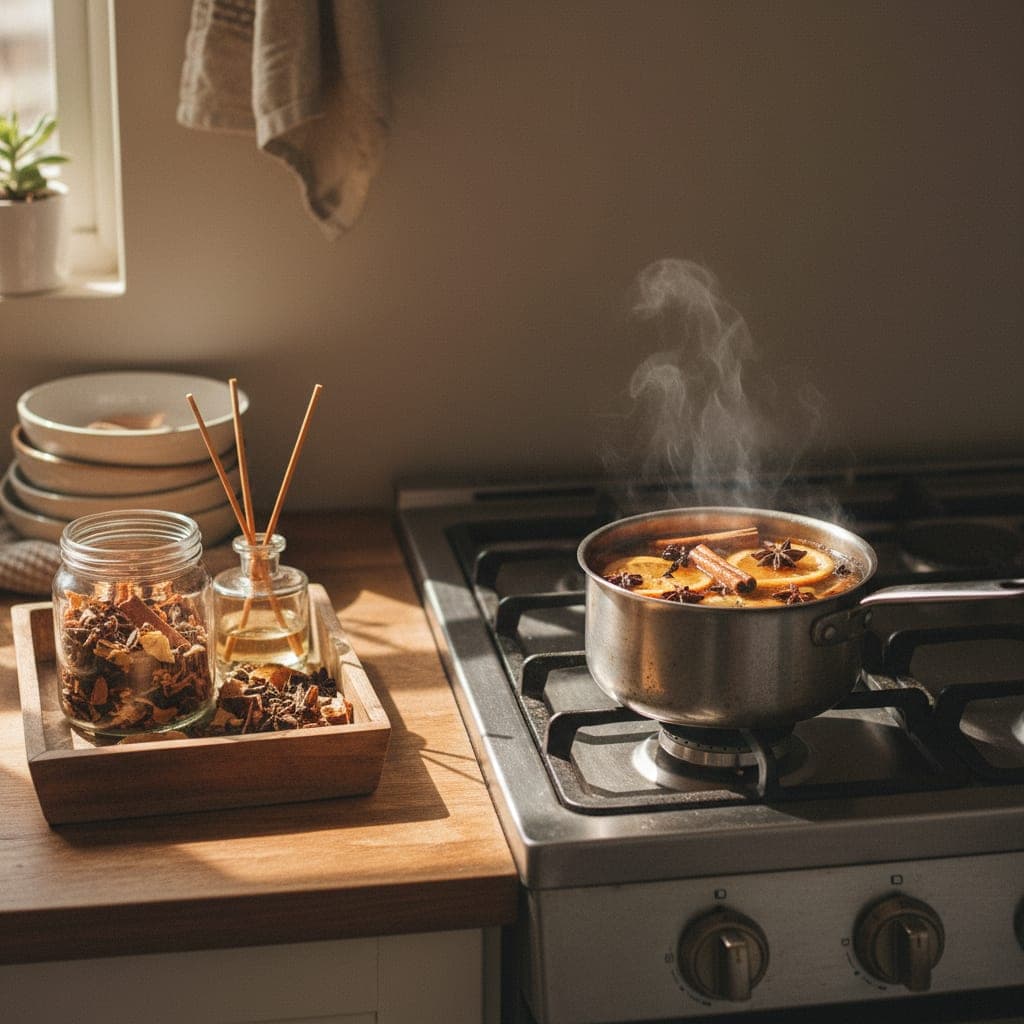
Fill a small saucepan with three cups of water. Add four cinnamon sticks (not ground cinnamon for this step), a tablespoon of whole cloves, the peel of one orange (use a vegetable peeler to take just the colored zest, not the white pith underneath), and one teaspoon of vanilla extract. The pith is bitter and contributes nothing to the aroma; the colored zest contains all of the orange essential oil that pairs with cinnamon. Bring the pot to a low boil on the smallest burner with the lid on for the first five minutes, then drop the heat to the lowest possible simmer with the lid removed so the steam carries the aroma into the room. The combination of cinnamon, clove, orange, and vanilla is the same aromatic profile used in commercial cinnamon-bun candles and reads as warm baked-goods cinnamon to almost everyone, where cinnamon alone reads more like potpourri or holiday garland. Top the pot up with hot water (not cold water, which will lower the simmer temperature too aggressively and pause the steam) every forty-five minutes. The simmer pot is the single highest-leverage cinnamon method for the kitchen and the room directly adjacent to it, and is the foundation that every other method on this list builds on top of. Never leave the pot unattended; if you need to step away for more than fifteen minutes, switch off the burner.
Use a slow cooker on low for whole-day coverage without supervision
If the goal is for the home to smell like cinnamon for an entire day rather than a few hours, transfer the same ingredients into a slow cooker on low instead of a stovetop saucepan. Use four cups of water, six cinnamon sticks, two tablespoons of whole cloves, the peel of two oranges, and two teaspoons of vanilla extract. The slow cooker maintains a steady gentle simmer for eight to ten hours without needing to be watched and without the fire risk of a stovetop pot left running unattended, which is the single biggest practical advantage and the reason most people end up using the slow cooker method permanently after trying both. Place the slow cooker on the kitchen counter with the lid slightly ajar (resting on a chopstick or the handle of a wooden spoon laid across the rim) so the steam can escape continuously rather than condensing back into the pot. Top up with hot water once mid-day, somewhere around the four-hour mark, and stir gently to redistribute the spices. Avoid placing the slow cooker directly under a kitchen cabinet, because the long heat exposure can dry out the wood and discolor the cabinet finish over time. A spot at the back of the kitchen island or a counter with open space above is ideal. The slow-cooker method is also the only practical option for an overnight session, because no stovetop pot should ever run while sleeping.
Move air through the home with the HVAC fan in continuous mode
The most common reason a cinnamon simmer pot only scents the kitchen is that there is no air movement carrying the scent into the rest of the home. A simmer pot generates a column of scented steam that rises straight up to the kitchen ceiling and then spreads laterally only as far as the natural air convection of the kitchen will take it, which is rarely past the doorway. Switch the thermostat fan setting from auto (where the fan only runs while heating or cooling is active) to on (where the fan runs continuously regardless of heating or cooling demand). The HVAC blower will run continuously in the background, pulling air across every supply register and pushing it through the ducts to every room of the home, including the rooms that are nominally closed off from the kitchen by stairs or doors. Within thirty minutes of starting the simmer pot with the fan in continuous mode, the scent will be present in upstairs bedrooms and remote bathrooms it would otherwise never reach, and within ninety minutes the scent intensity is roughly even from the kitchen to the farthest bedroom. The continuous-fan setting adds a small amount to the monthly electric bill (typically under fifteen dollars per month even with the fan running constantly) and slightly increases the workload on the blower motor, so reserve continuous mode for the days when the cinnamon scent matters and switch the fan back to auto at bedtime or whenever the simmer pot has been turned off.
Place a small bowl of ground cinnamon near each return vent
Pour two tablespoons of ground cinnamon into a small heat-safe bowl. Place one bowl on a shelf near each return air vent in the home, ideally within a foot of the return-vent grille so the airflow is strong enough to pick up the cinnamon aroma. As the HVAC fan pulls air through the return, the air picks up the cinnamon aroma directly from the bowl and distributes it through the ducts to every supply vent in the home. This is a passive method that works without any heat or open flame and lasts for two to three days before the cinnamon needs to be refreshed. Use ground cinnamon, not sticks, because the larger surface area of the powder releases scent faster than the closed sticks; sticks barely register on a passive air pull. Replace the cinnamon when the smell stops being noticeable rather than discarding it on a fixed schedule, because humidity and ambient temperature in the room dramatically change how fast the powder releases its aroma. In a dry winter room with the heat running, two tablespoons may be exhausted in thirty-six hours; in a humid summer room with the air conditioner running, the same two tablespoons may last five days. Stir the bowl with a fork once a day to expose fresh powder. Avoid placing the bowls anywhere a pet can reach them, because dogs in particular will investigate any open bowl and ground cinnamon is a respiratory irritant if a pet sniffs deeply.
Toss a stick of cinnamon into the running vacuum bag or canister
Drop one cinnamon stick into the vacuum canister or break a stick into pieces and drop them into a bagged vacuum before vacuuming the carpet or rug. As the vacuum runs, the airflow inside the vacuum tumbles the cinnamon stick and pushes warm cinnamon-scented air out the exhaust port at the back or top of the vacuum, depending on the model. The room being vacuumed picks up the cinnamon scent as the carpet is being cleaned, which is a more durable method than spraying air freshener after vacuuming, because the carpet itself becomes a faint scent source for the next several hours through the cinnamon residue that the airflow has deposited into the carpet fibers. The trick also pairs with a cinnamon-and-baking-soda carpet refresher described in step seven, and the two methods stack: dropping a stick into the vacuum and then vacuuming a cinnamon-and-baking-soda treatment is the most aromatic single vacuuming session you will ever experience and turns a routine chore into a noticeable scent event. Replace the cinnamon stick or pieces every three vacuuming sessions, because the heat and airflow inside a vacuum dries the stick rapidly and the aroma drops off after the third session. Avoid using ground cinnamon in a bagless vacuum because the powder will pass through the cyclone filter into the motor housing where it cannot easily be cleaned out and may contribute to a faint scorched-cinnamon smell over time.
Sprinkle cinnamon-and-baking-soda over rugs, wait fifteen minutes, then vacuum
Mix one cup of baking soda with two tablespoons of ground cinnamon in a small bowl, stirring with a fork until the cinnamon is fully dispersed and the mixture is uniformly tan-colored with no white streaks. The baking soda is the active ingredient for odor absorption; the cinnamon is the scent layer that rides along with the baking soda into the carpet fibers. Sprinkle the mixture evenly over the rug or carpet, focusing on high-traffic paths from the doorway to the seating area. Use the back of a soft-bristle broom to lightly work the mixture into the carpet pile rather than letting it sit only on top, because the brushed-in mixture absorbs trapped odors much more thoroughly than a surface-only application. Let the mixture sit for fifteen minutes so the baking soda absorbs trapped odors and the cinnamon scent transfers into the fibers; for a heavily soiled rug or one that has absorbed pet odors, extend the wait to thirty minutes for measurably better odor removal. Vacuum thoroughly with overlapping passes, going over the rug in two perpendicular directions to lift the mixture from every angle of the pile. The rug will quietly release a soft cinnamon background scent every time someone walks across it for the next two days, and the deeper odor reduction from the baking soda is permanent until the next round of cooking smells or pet activity adds new odors. This is the highest-leverage method for fabric-heavy rooms such as a carpeted bedroom or a living room with a large area rug. Spot-test on a corner first if the rug is a delicate hand-knotted or oriental piece, because some natural-fiber rugs can hold the cinnamon residue more than synthetic rugs do.
Add a few drops of cinnamon essential oil to a cotton ball in each closet
Place two drops of cinnamon essential oil onto a cotton ball and tuck the cotton ball onto a shelf inside each closet, including coat closets, linen closets, and the small storage closet under the stairs if there is one. The closed environment concentrates the scent so the closet itself becomes a quiet scent reservoir, and every time the door is opened a small wave of cinnamon enters the adjacent room. This is the longest-lasting passive method on the entire list, and once it is set up it requires almost no daily attention. Replace the cotton ball every ten to fourteen days when the smell fades; if the cotton ball still smells strongly at fourteen days, the closet has unusually low humidity and the oil is evaporating slowly, in which case stretch to twenty-one days. Use cinnamon-bark essential oil rather than cinnamon-leaf, because bark oil reads as the warmer baked-goods cinnamon while leaf oil leans more medicinal and slightly harsh, more like a topical analgesic than a kitchen scent. Place the cotton ball in a small open dish or on a folded paper towel rather than directly on a wooden shelf, because cinnamon essential oil can stain or eat into the finish of an unfinished wood shelf if it sits in direct contact for several weeks. Keep the cotton balls completely out of reach of dogs and cats; cinnamon oil is irritating to pet skin and respiratory systems and can cause vomiting if a pet ingests the cotton ball. Never apply the oil to skin without dilution in a carrier oil.
Bake or warm something cinnamon-based in the oven once a week
The most authentic cinnamon scent in any home is the one that comes from actual baking, because the high oven temperature releases volatile aromatic compounds from the cinnamon that no simmer pot or essential oil can fully replicate. Once a week, warm a tray of store-bought cinnamon rolls (the refrigerated tube kind is fine for this purpose; nobody is going to grade the rolls), bake a quick cinnamon-sugar dusted apple sliced in half with the core removed, or simply heat a small ramekin of butter with cinnamon and brown sugar at three hundred degrees for ten minutes. Even the simplest of these (the butter-and-cinnamon ramekin) is enough to flood the kitchen with a convincing fresh-baked cinnamon scent. The oven heat carries the scent through the kitchen and, if the HVAC fan is in continuous mode, through the rest of the home within thirty minutes. This single weekly habit is what turns a cinnamon-scented home from artificial to convincing, because the human nose subconsciously associates real-baking cinnamon with kitchen activity in a way that no candle or simmer pot quite captures. Schedule the oven warm-up for whichever day of the week is most likely to coincide with guests arriving, and the lingering aroma will still be detectable two to three hours after the oven has been turned off. Crack the oven door open for the last two minutes of the heating session to push the warm aromatic air into the kitchen rather than letting it stay trapped inside the oven.
Layer the routine across morning, afternoon, and evening for full-day coverage
The full layered routine that produced an even cinnamon scent in every room of a two-story home was: slow-cooker simmer pot starting at seven in the morning with the lid cracked open on a chopstick, return-vent cinnamon bowls refreshed at the same time with two new tablespoons of ground cinnamon in each bowl, HVAC fan switched to continuous mode at the same time so the morning startup of the simmer pot has time to distribute through the ducts before anyone is awake to notice the kitchen scent specifically, cinnamon-and-baking-soda carpet pass on the highest-traffic rug at midday once the morning routines have wrapped up, and a tray of warmed cinnamon rolls or a baked cinnamon apple at five in the evening before any guests arrived for dinner. The closet cotton balls work in the background continuously without daily attention and were refreshed weekly. This layered approach is the difference between a home that smells like cinnamon in the kitchen and a home that smells like cinnamon throughout, including in upstairs bedrooms and the second-floor hallway. The pattern is most effective on a day when the home will be occupied for most of the day rather than empty, because air circulation depends on doors being opened and closed and on the small air movements created by people walking from room to room. On a fully empty day with the HVAC fan on auto, even this full layered routine will scent only the ground floor.
What to skip and what to never combine
Cinnamon-scented plug-in air fresheners almost universally read as artificial when paired with any of the natural methods on this list. The combination of a real simmer pot and a synthetic plug-in produces a chemical-cinnamon hybrid that is worse than either alone, because the human nose is sensitive to the difference between natural cinnamon aldehyde and the synthetic cinnamaldehyde-mimics used in plug-in fragrance, and the two simultaneously create an uncanny-valley effect rather than reinforcing each other. Choose one approach. If the goal is convenience and the home will not be supervised, use only the plug-in and skip the simmer pot. If the goal is the warmest and most convincing scent, use the natural methods and unplug every cinnamon air freshener in the home before starting. Never combine cinnamon scent with vanilla candles plus citrus candles in the same room. The three together compete and the result is muddy. If a cinnamon background scent is the goal, use orange peel inside the simmer pot itself for citrus rather than a separate citrus candle in the same room, and use vanilla extract inside the simmer pot for vanilla rather than a separate vanilla candle. Combining the scents inside one simmer pot blends them into a single coherent aroma; combining them across multiple sources in the same room produces a layered competition that the nose registers as confused. Finally, do not run a cinnamon simmer pot on the stovetop overnight while sleeping. Use the slow cooker for overnight coverage instead. The fire risk of a stovetop pot is small but real and not worth the marginal improvement in scent intensity, and several house fires per year are traced to unattended stovetop simmer pots that ran dry in the early morning hours.
Pro Tips
- Use cinnamon-bark essential oil, not cinnamon-leaf, for the warmer baked-goods cinnamon profile.
- Switch the thermostat fan from auto to on whenever a simmer pot or oven warm-up is running, so the scent reaches every room.
- Refresh return-vent cinnamon bowls with two new tablespoons every three days rather than topping up the old powder.
Frequently Asked Questions
What is the easiest way to make my whole house smell like cinnamon?
Run a slow-cooker simmer pot on low containing cinnamon sticks, whole cloves, orange peel, and vanilla extract, and switch the HVAC thermostat fan from auto to on so the blower runs continuously. The continuous fan pulls scented air across every return vent and distributes it through the ducts to every room of the home, including upstairs bedrooms and remote bathrooms that a kitchen simmer pot alone never reaches.
How long does cinnamon scent last in a home?
An active simmer pot scents the kitchen and the adjacent room for as long as it is running. Passive methods such as cinnamon bowls near return vents and cinnamon-and-baking-soda vacuumed into rugs scent the surrounding rooms for two to three days. A cinnamon essential-oil cotton ball inside a closed closet lasts ten to fourteen days. The most durable cinnamon presence in a home comes from layering all three methods rather than relying on any one of them alone.
Is cinnamon safe to use around pets?
Whole cinnamon sticks in a simmer pot and small bowls of ground cinnamon near return vents are generally safe around dogs and cats as long as the pets cannot directly reach the bowls or the simmer pot. Cinnamon essential oil is significantly more concentrated and is irritating to pet skin and respiratory systems. Keep all cotton balls dosed with essential oil in closed closets that pets do not enter, and never diffuse cinnamon essential oil heavily in a closed room with a bird, since birds are extremely sensitive to airborne oils. When in doubt, use the simmer-pot and ground-cinnamon methods only and skip the essential-oil step.
Can I use ground cinnamon in a simmer pot instead of sticks?
Yes, but ground cinnamon will cloud the water within ten minutes and leave a thin sediment layer on the bottom of the pot. Ground cinnamon also burns more easily if the water level drops. Cinnamon sticks are the better choice for a simmer pot. Reserve ground cinnamon for the passive bowls placed near return vents and for the cinnamon-and-baking-soda carpet refresher.
Will cinnamon mask cooking smells like onion or fish?
Cinnamon is most effective as a layered top note over a clean baseline rather than as a cover for an active strong cooking smell. Address the cooking smell first using the steps in our onion-smell guide, which uses simmering vinegar and the range hood to neutralize the source. Once the baseline is neutral, the cinnamon simmer pot creates the warm finishing scent. Trying to layer cinnamon directly over an active onion or fish smell produces a muddier composite than either smell alone.
How this guide was made
This Home Fragrance guide was researched, written, edited, and published by Fredler Pierre-Louis. The 11 steps below are built around Cinnamon sticks, Ground cinnamon and Whole cloves, and the quantities and dwell times come from published cleaning-chemistry and manufacturer guidance for those materials, not from a controlled trial we ran ourselves. Where a popular version of this hack does not work, or is risky on a particular surface, this 10 min guide says so.
- Checked against manufacturer and materials guidance for the surfaces named.
- Reviewed by a person for chemical safety and surface compatibility before publication.
- Written to explain why a method works, not just to list steps.
- Corrected whenever a reader reports an error or an edge case we missed.
Read our full editorial policy or learn more about the team behind TryCleaningHacks.
Related Cleaning Guides
Safety Notes
- Never leave a stovetop simmer pot unattended. Use a slow cooker for any session longer than ninety minutes.
- Cinnamon essential oil is irritating to skin and to pets. Keep cotton balls out of reach of dogs and cats and never apply oil directly to skin without a carrier oil.
- Top up simmer pots with water every forty-five minutes. A dry pan on a hot burner can crack ceramic cookware and cause a kitchen fire.
You might also like
10 Easy Ways to Make Your House Smell Amazing All Day
I threw out every plug in and aerosol can in my house two years ago and switched to these ten methods instead. The simmer pot gets more genuine "what is that smell, it's incredible" comments than any candle I ever burned, and it costs almost nothing. Here is what actually holds up day after day, which tricks are overhyped, and the one habit that matters more than any fragrance you add on top.
How to Get Onion Smell Out of the House
I diced two large onions for a stew on a Sunday and the smell was still hanging in the curtains on Tuesday. After timing four different deodorizing methods over a real onion-cooking session, here is the order that actually clears the air fastest and the mistakes that just spread the smell to other rooms.
How to Get Garlic Smell Out of the House
I roasted three whole heads of garlic for a Sunday pasta and the smell was still clinging to the dish towels two days later. After timing the methods that actually cleared the air against the ones that only spread the smell, here is the order that worked fastest and the mistakes that kept the garlic ghost hanging around until midweek.